No results
Reduced price! BPC 157 5mg +

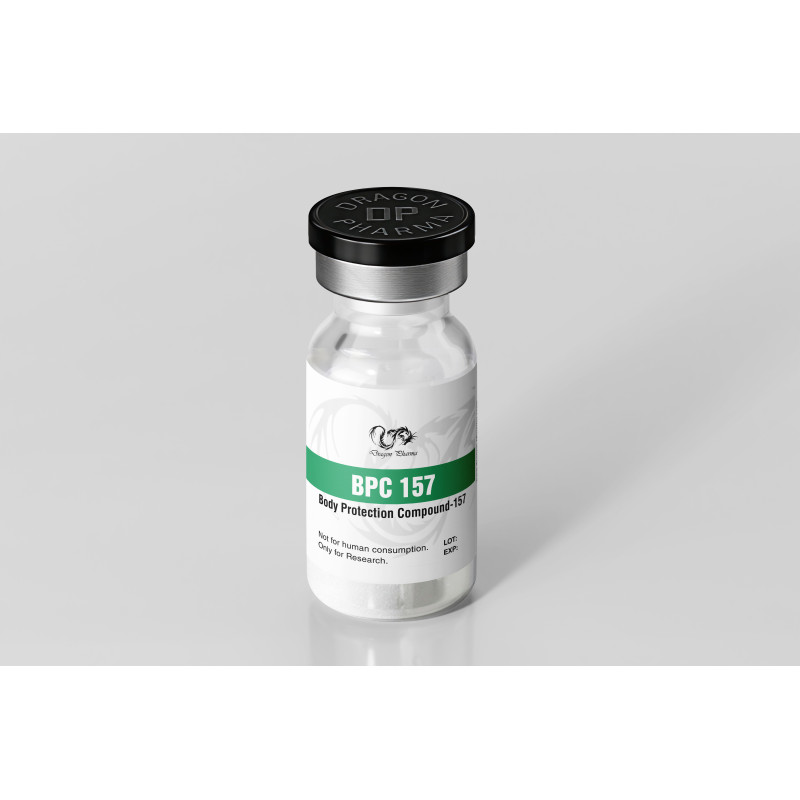
BPC 157 5mg

$38

$23

Manufacturer: Dragon Pharma
Substance: Pentadecapeptide BPC 157
Package: BPC 157 2ml (powder form)

Description

Pharmaceutical-Grade BPC-157 for Research Applications

Dragon Pharma BPC-157 is a premium-quality synthetic peptide manufactured to high laboratory standards for scientific and research purposes. This stable gastric pentadecapeptide consists of 15 amino acids and is derived from a naturally occurring protective protein found in human gastric juice. Due to its exceptional stability in acidic environments and resistance to enzymatic degradation, BPC-157 has become one of the most extensively studied peptides in regenerative medicine and experimental tissue repair research.

Every Dragon Pharma batch is produced under strict quality control procedures to ensure purity, consistency, and molecular integrity. The peptide is supplied as a lyophilized (freeze-dried) powder without unnecessary fillers, helping preserve its stability during storage and transportation while maintaining reliable performance for laboratory use.

Peptide Specifications

PropertyValue
ProductDragon Pharma BPC-157
Peptide TypeSynthetic Pentadecapeptide
Amino Acid SequenceGly-Glu-Pro-Pro-Pro-Gly-Lys-Pro-Ala-Asp-Asp-Ala-Gly-Leu-Val
Molecular FormulaC62H98N16O22
Molecular Weight1419.5 g/mol
CAS Number137525-51-0
PubChem CID108101
FormLyophilized Peptide Powder
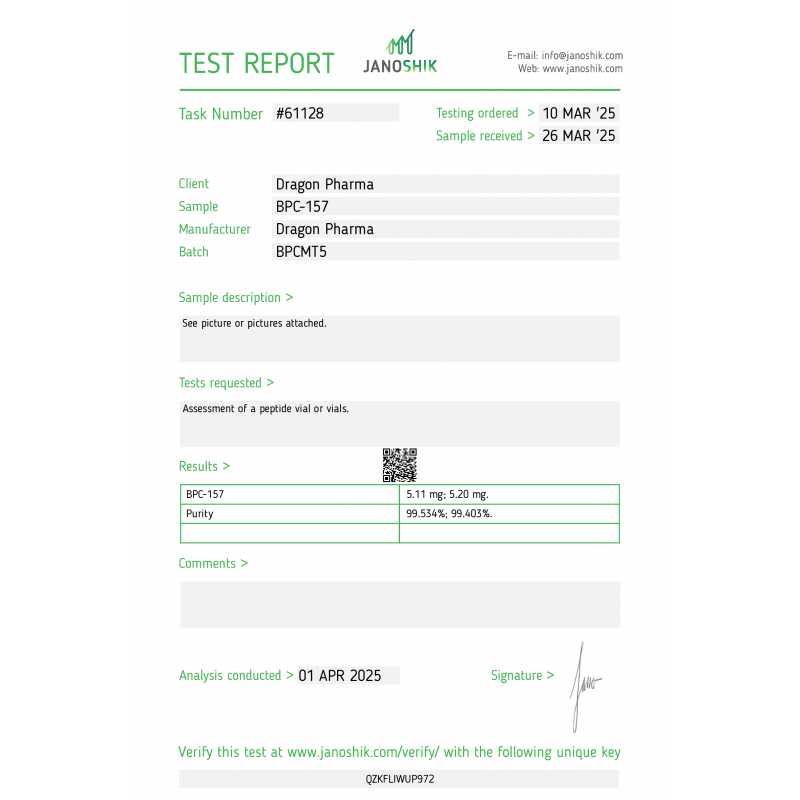
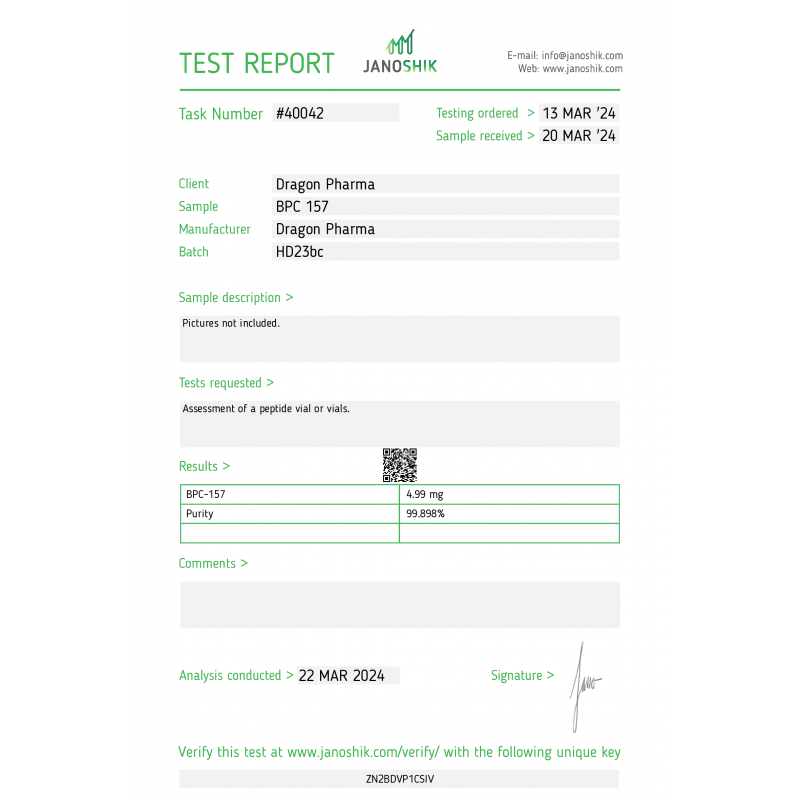
PurityLaboratory Tested
Research ClassificationResearch Use Only

Molecular Structure and Stability

BPC-157 is composed of fifteen amino acids arranged in a highly stable sequence that demonstrates remarkable resistance to hydrolysis and enzymatic degradation. Unlike many peptides that rapidly break down under acidic conditions, BPC-157 maintains structural integrity even within gastric environments, making it an important compound for gastrointestinal and regenerative research.

Its molecular characteristics have attracted significant attention in experimental studies investigating connective tissue repair, vascular biology, collagen synthesis, and cellular regeneration.

Mechanism of Action

Current research suggests that BPC-157 interacts with multiple biological pathways involved in tissue regeneration and cellular repair. Rather than acting through a single mechanism, the peptide appears to influence several signaling systems simultaneously.

Experimental studies have investigated its relationship with:

  • Growth Hormone Receptor (GHR) signaling
  • JAK2 activation
  • ERK1/2 signaling pathways
  • FAK-paxillin pathway
  • VEGF and VEGFR2 expression
  • Akt-eNOS signaling
  • Src-Caveolin-1 pathway
  • Nitric Oxide (NO) regulation

These pathways are associated with fibroblast activity, endothelial cell migration, collagen production, angiogenesis, vascular remodeling, and normal tissue regeneration.

Areas of Scientific Research

Wound Healing Research

BPC-157 has become one of the most investigated peptides for experimental wound healing models. Published studies have examined its influence on granulation tissue formation, collagen deposition, angiogenesis, fibroblast migration, and epithelial regeneration.

Researchers continue to explore its potential role in skin repair, surgical incisions, burn models, diabetic ulcers, and other experimental tissue injury models.

Tendon and Ligament Research

Experimental models have demonstrated promising findings involving tendon fibroblast proliferation, ligament regeneration, and connective tissue remodeling.

Research has investigated BPC-157 in relation to:

  • Tendon healing
  • Ligament repair
  • Tendon-to-bone attachment
  • Myotendinous junction recovery
  • Collagen synthesis
  • Fibroblast survival
  • Cell migration

These observations have made the peptide a frequent subject in musculoskeletal research.

Muscle Recovery Studies

Animal research has evaluated BPC-157 for its potential effects on skeletal muscle regeneration following injury. Experimental findings suggest improved muscle architecture, reduced tissue degeneration, enhanced vascularization, and functional recovery in controlled laboratory settings.

Bone Regeneration Research

Several preclinical studies have investigated the peptide's involvement in bone remodeling and the healing of segmental bone defects. Researchers continue to evaluate how BPC-157 may influence osteogenesis, connective tissue integration, and bone repair processes.

Angiogenesis and Vascular Biology

One of the defining characteristics of BPC-157 research is its association with angiogenesis—the formation of new blood vessels.

Experimental studies indicate that BPC-157 may influence:

  • VEGF expression
  • VEGFR2 activation
  • Endothelial cell proliferation
  • Nitric oxide production
  • Blood vessel formation
  • Microvascular circulation
  • Vascular endothelial function

These mechanisms remain active areas of investigation across multiple fields of regenerative research.

Gastrointestinal Research

As a peptide originally derived from gastric protective proteins, BPC-157 has been widely studied in gastrointestinal models.

Published research has explored its potential involvement in:

  • Gastric mucosal protection
  • Intestinal permeability
  • Cytoprotection
  • Experimental gastric ulcers
  • Duodenal lesions
  • NSAID-induced gastrointestinal injury
  • Alcohol-induced gastric damage
  • Stress-related gastric injury
  • Experimental ulcerative colitis
  • Gastrointestinal fistula models

These findings continue to support additional research into gastrointestinal tissue protection and recovery.

Ocular Research

More recent investigations have expanded into ophthalmic applications.

Experimental studies have evaluated BPC-157 in laboratory models involving:

  • Retinal ischemia
  • Glaucoma
  • Corneal wound healing
  • Corneal epithelial regeneration
  • Ocular vascular health
  • Dry eye research
  • Retinal ganglion cell preservation

Although these findings remain experimental, they further demonstrate the peptide's broad research interest.

Lyophilized Peptide Technology

Dragon Pharma BPC-157 is supplied in a lyophilized form using advanced freeze-drying technology.

Benefits of lyophilization include:

  • Improved molecular stability
  • Extended shelf life
  • Better storage characteristics
  • Reduced degradation
  • Preservation of peptide purity
  • Reliable reconstitution for laboratory protocols

No unnecessary fillers are added during manufacturing.

Storage and Handling

For optimal stability, store the lyophilized peptide in a cool, dry environment away from direct sunlight.

Following laboratory reconstitution, researchers commonly store the solution under refrigeration according to established laboratory protocols. Proper handling helps preserve peptide integrity throughout experimental use.

Quality Assurance

Dragon Pharma follows rigorous manufacturing and quality control procedures to deliver reliable research compounds.

Every production batch undergoes comprehensive laboratory evaluation, including:

  • Identity verification
  • Purity assessment
  • Molecular weight confirmation
  • Batch consistency analysis
  • Manufacturing quality control
  • Contaminant screening

Independent analytical methods such as High-Performance Liquid Chromatography (HPLC) and Liquid Chromatography-Mass Spectrometry (LC-MS) are widely recognized as industry standards for peptide verification and quality assessment.

Why Choose Dragon Pharma BPC-157?

Researchers choose Dragon Pharma because of its commitment to consistent manufacturing standards and product quality.

Key advantages include:

  • Pharmaceutical-grade manufacturing
  • High-purity lyophilized peptide
  • No unnecessary fillers
  • Stable molecular composition
  • Batch-tested quality
  • Advanced laboratory quality control
  • Reliable peptide integrity
  • Trusted Dragon Pharma manufacturing standards

Scientific References

The information presented on this page is based on peer-reviewed scientific publications investigating BPC-157 in preclinical and laboratory research. While experimental findings have demonstrated promising biological activity across multiple research models, Dragon Pharma supplies BPC-157 exclusively for laboratory and research purposes. This product is not intended for human consumption or therapeutic use.

  1. Seiwerth S, Milavic M, Vukojevic J, et al. Stable Gastric Pentadecapeptide BPC 157 and Wound Healing. Frontiers in Pharmacology. 2021;12:627533.
    https://doi.org/10.3389/fphar.2021.627533

  2. Huang T, Zhang K, Sun L, et al. Body Protective Compound-157 Enhances Alkali-Burn Wound Healing in Vivo and Promotes Proliferation, Migration, and Angiogenesis in Vitro. Drug Design, Development and Therapy. 2015;9:2485-2499.
    https://doi.org/10.2147/DDDT.S82030

  3. Chang CH, Tsai WC, Lin MS, Hsu YH, Pang JHS. The Promoting Effect of Pentadecapeptide BPC 157 on Tendon Healing Involves Tendon Outgrowth, Cell Survival, and Cell Migration. Journal of Applied Physiology. 2011;110(3):774-780.
    https://doi.org/10.1152/japplphysiol.00945.2010

  4. Chang CH, Tsai WC, Hsu YH, Pang JHS. Pentadecapeptide BPC 157 Enhances Growth Hormone Receptor Expression in Tendon Fibroblasts. Molecules. 2014;19(11):19066-19077.
    https://doi.org/10.3390/molecules191119066

  5. Hsieh MJ, Liu HT, Wang CN, et al. Therapeutic Potential of Pro-Angiogenic BPC157 Is Associated with VEGFR2 Activation and Up-Regulation. Journal of Molecular Medicine. 2017;95(3):323-333.
    https://doi.org/10.1007/s00109-016-1488-y

  6. Hsieh MJ, Lee CH, Chueh HY, et al. Modulatory Effects of BPC 157 on Vasomotor Tone and the Activation of Src-Caveolin-1-eNOS Pathway. Scientific Reports. 2020;10.
    https://doi.org/10.1038/s41598-020-74022-y

  7. Park JM, Lee HJ, Sikiric P, Hahm KB. BPC157 Rescued NSAID Cytotoxicity via Stabilizing Intestinal Permeability and Enhancing Cytoprotection. Current Pharmaceutical Design. 2020.
    https://doi.org/10.2174/1381612826666200523180301

  8. Zlatar M, Kokot A, Vuletić L, et al. BPC 157 as a Therapy for Retinal Ischemia Induced by Retrobulbar Application of L-NAME in Rats. Frontiers in Pharmacology. 2021;12.
    https://doi.org/10.3389/fphar.2021.632295

  9. Sikiric P, Kokot A, Kralj T, et al. Stable Gastric Pentadecapeptide BPC 157—Possible Novel Therapy of Glaucoma and Other Ocular Conditions. Pharmaceuticals. 2023;16(7):1052.
    https://doi.org/10.3390/ph16071052

  10. He L, Feng D, Guo H, et al. Pharmacokinetics, Distribution, Metabolism, and Excretion of Body-Protective Compound 157, a Potential Drug for Treating Various Wounds, in Rats and Dogs. Frontiers in Pharmacology. 2022;13.
    https://doi.org/10.3389/fphar.2022.1026182

Research Use Disclaimer

Dragon Pharma BPC-157 is supplied exclusively for laboratory research and scientific investigation. This compound is intended for qualified researchers and must only be used in accordance with applicable research regulations. It is not approved for human consumption, medical treatment, diagnosis, or therapeutic use.

Details

  • Route of administration
    Injection

Reviews

Write a review

BPC 157 5mg

BPC 157 5mg

Manufacturer: Dragon Pharma
Substance: Pentadecapeptide BPC 157
Package: BPC 157 2ml (powder form)