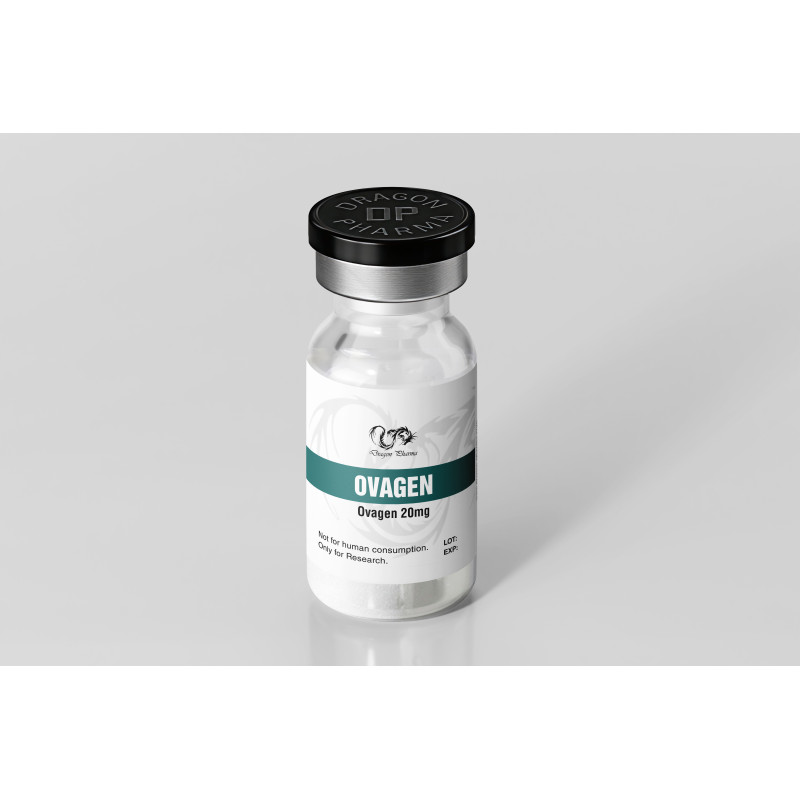
Dragon Pharma Ovagen is a premium-quality synthetic peptide bioregulator manufactured to rigorous laboratory standards for scientific and research applications. Based on the amino acid sequence H-Glu-Asp-Leu-OH, Ovagen is a short tripeptide that has attracted scientific interest for its potential role in cellular regulation, hepatic biology, gastrointestinal physiology, and peptide signaling.
Peptide bioregulators have been investigated for their ability to influence cellular communication, gene expression, tissue homeostasis, and regenerative processes. Ovagen belongs to a family of low-molecular-weight peptides originally developed for experimental research into organ-specific biological regulation. Its molecular characteristics have made it an important subject in laboratory investigations involving liver function, gastrointestinal tissue biology, protein interactions, and cellular metabolism.
Every batch of Dragon Pharma Ovagen is manufactured under strict quality control procedures to ensure exceptional purity, consistency, and molecular integrity. The peptide is supplied as a lyophilized (freeze-dried) powder without unnecessary fillers, preserving stability during storage while providing dependable performance for laboratory research.
| Property | Value |
|---|---|
| Product | Dragon Pharma Ovagen |
| Peptide Type | Synthetic Tripeptide Bioregulator |
| Peptide Sequence | H-Glu-Asp-Leu-OH |
| Molecular Formula | C15H25N3O8 |
| Molecular Weight | 375.37 g/mol |
| PubChem CID | 444128 |
| Form | Lyophilized Peptide Powder |
| Purity | Laboratory Tested |
| Research Classification | Research Use Only |
Ovagen is a low-molecular-weight tripeptide composed of glutamic acid, aspartic acid, and leucine. Short regulatory peptides are increasingly studied for their ability to participate in intracellular signaling, protein interactions, and tissue-specific biological regulation.
Experimental investigations suggest that peptides of this class may influence cellular homeostasis, protein synthesis, tissue remodeling, and molecular communication within hepatic and gastrointestinal systems. Due to its compact molecular structure and biological stability, Ovagen has become a valuable research compound for studying peptide-mediated regulatory mechanisms in vitro.
Current laboratory research indicates that Ovagen may participate in molecular pathways associated with cellular regulation and tissue-specific peptide signaling.
Experimental investigations have explored its relationship with:
Research into these mechanisms continues to improve scientific understanding of peptide-mediated biological regulation and tissue-specific molecular activity.
Ovagen has primarily been investigated as a peptide bioregulator for laboratory studies involving liver biology and hepatic physiology.
Experimental research has examined its potential relationship with:
These investigations continue to expand knowledge of peptide regulation within hepatic tissues.
Research has also explored Ovagen within models investigating gastrointestinal physiology and digestive tissue biology.
Published laboratory studies have examined:
These investigations contribute to broader understanding of gastrointestinal cellular function and peptide-mediated regulation.
Peptide bioregulators have become increasingly important tools for studying fundamental cellular biology.
Current research involving Ovagen includes investigation into:
These biological processes remain active areas of laboratory investigation.
One of the best-characterized laboratory applications of the Glu-Asp-Leu sequence involves protein interaction studies.
Experimental investigations have demonstrated competitive interactions with HIV-1 protease in vitro, where the tripeptide functions as a competitive inhibitor derived from the viral transframe region (TFR). These studies have provided valuable insights into peptide-enzyme recognition, molecular binding, enzyme inhibition, and structure-activity relationships.
Researchers continue using these findings to investigate peptide-based molecular interactions and protein recognition mechanisms.
The relatively simple structure of Ovagen makes it an excellent model for studying peptide chemistry and molecular biology.
Current laboratory investigations include:
These studies contribute to understanding how small regulatory peptides influence biological systems at the molecular level.
Dragon Pharma Ovagen is manufactured as a lyophilized peptide using advanced freeze-drying technology to maximize molecular stability and preserve peptide integrity throughout storage and laboratory handling.
Benefits of lyophilization include:
For optimal stability, store the lyophilized peptide in a cool, dry environment protected from heat, moisture, and direct sunlight.
Following laboratory reconstitution, peptide solutions are commonly stored under refrigeration according to established laboratory protocols. Proper storage and handling help preserve peptide stability and molecular integrity throughout experimental research.
Dragon Pharma follows rigorous manufacturing and quality assurance standards to deliver dependable research compounds.
Every production batch undergoes comprehensive laboratory evaluation, including:
Analytical methods such as High-Performance Liquid Chromatography (HPLC) and Liquid Chromatography-Mass Spectrometry (LC-MS) are recognized industry standards for confirming peptide identity, purity, and molecular integrity.
Researchers choose Dragon Pharma because of its commitment to pharmaceutical-quality manufacturing and dependable research compounds.
The information presented on this page is based on published peer-reviewed scientific literature investigating Ovagen peptides and the Glu-Asp-Leu tripeptide in laboratory and preclinical research. Studies have explored peptide bioregulation, protein interactions, hepatic biology, gastrointestinal physiology, molecular recognition, and HIV-1 protease inhibition.
Dragon Pharma supplies Ovagen exclusively for laboratory research purposes.
Dragon Pharma Ovagen is supplied exclusively for laboratory research and scientific investigation. This peptide is intended for qualified researchers and must only be used in accordance with applicable research regulations. It is not approved for human consumption, medical treatment, diagnosis, or therapeutic use.