No results
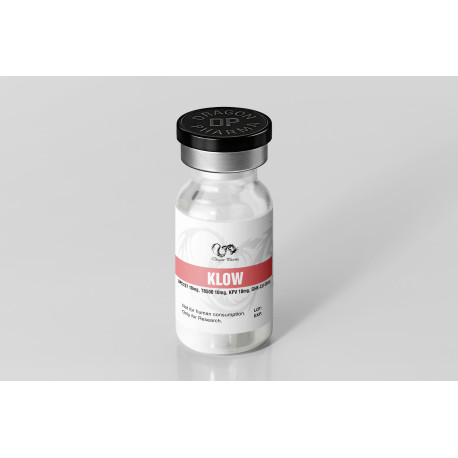
Reduced price! KLOW 70mg +

KLOW 80mg

$190

$114

NEW

Manufacturer: Dragon Pharma
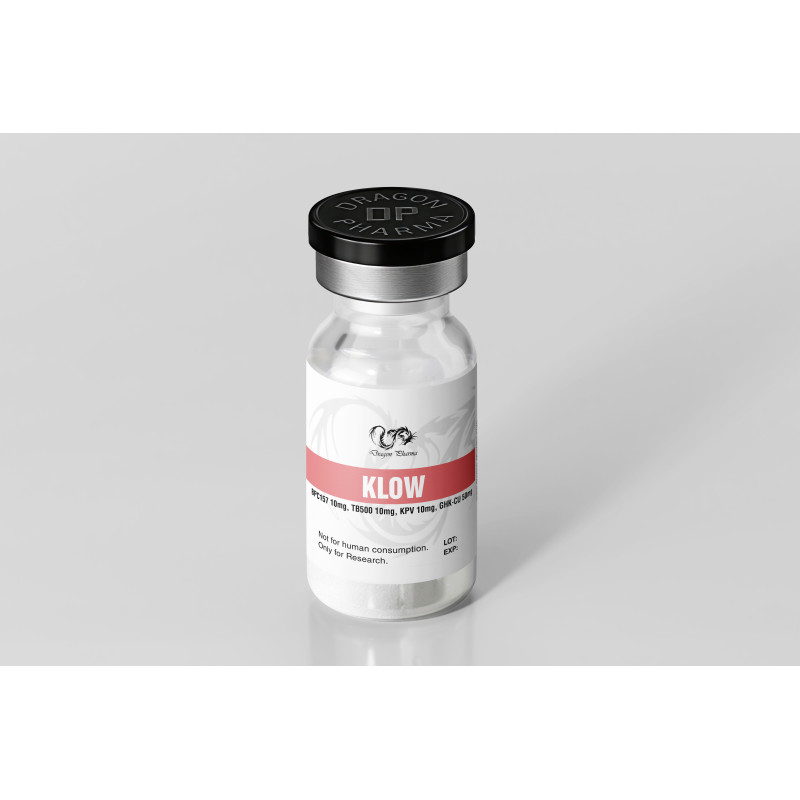
Substance: KPV 10 mg, BPC 157 10mg, TB500 10mgGHK-Cu 50mg
Package: 1 vial (powder form)

Description

Dragon Pharma KLOW Peptide Blend

Dragon Pharma KLOW 80mg is a pharmaceutical-grade four peptide blend combining GHK-Cu 50mg, BPC-157 10mg, TB-4 10mg, and KPV 10mg in a single lyophilized vial — assigning one peptide to each of the four biological bottlenecks that determine whether skin repair, collagen rebuilding, and inflammatory control actually succeed.

Most collagen interventions address one bottleneck and ignore the others. GHK-Cu without BPC-157 has the collagen signal but no capillary supply to deliver raw material to the repair site. BPC-157 without KPV builds blood vessels into a tissue environment where reactive inflammation can still drown the rebuilding signals. The Dragon Pharma KLOW peptide blend is built around the recognition that skin repair requires all four systems working simultaneously — not sequentially, not independently, but in coordinated parallel.

What Each Peptide Does — One Bottleneck Per Compound

GHK-Cu — Collagen Architecture and Matrix Clearance

GHK-Cu is a copper-binding tripeptide mapped across more than 4,000 genes — collagen synthesis, antioxidant defense, and wound-healing programs trend upward while inflammation and tissue-breakdown programs trend downward. Circulating GHK-Cu levels decline with age — from approximately 200 ng/mL at age 20 to roughly 80 ng/mL by age 60 — a progressive deficit that directly correlates with the structural collagen loss visible as skin aging.

What distinguishes GHK-Cu from standard collagen interventions is its dual action: it clears damaged extracellular matrix at the same time as laying down new collagen structure through lysyl oxidase cross-linking. Most collagen interventions only do the second. The copper it carries also turns the reconstituted KLOW solution blue — and produces the brief 30–60 second sting on injection that confirms the copper peptide is present and active.

BPC-157 — Vascular Supply to the Repair Site

BPC-157 is a 15-amino-acid fragment derived from gastric juice, studied across more than 100 preclinical repair models. Its primary role in the KLOW blend is angiogenic signaling — sprouting new capillaries into the dermal repair area to supply the nutrient and oxygen delivery that GHK-Cu's collagen synthesis demands. Without that capillary infrastructure, GHK-Cu has the signal but the raw material never reaches the work site.

BPC-157 also stabilizes tissue barriers so newly synthesized collagen holds together structurally as it forms — preventing the tissue disorganization that produces poor-quality repair outcomes.

TB-4 — Repair Cell Migration and Anti-Fibrotic Organization

Dragon Pharma KLOW 80mg uses full-length Thymosin Beta-4 (43 amino acids) — not the shorter TB-500 fragment commonly sold for injury work. Labels blur the two routinely; vial sequence identity matters. TB-4's mechanism operates through G-actin sequestration — governing how repair cells (fibroblasts) migrate into tissue and organize once they arrive. Its Ac-SDKP anti-fibrotic signaling biases healing toward functional organized tissue rather than rope-like scar formation — the difference between a repair that restores structure and one that simply fills the space.

KPV — Pre-Emptive Inflammation Control

KPV is a three-amino-acid fragment of alpha-MSH that stops inflammatory genes from switching on in the first place — through NF-κB pathway inhibition — rather than blocking inflammation after it has already started the way NSAIDs do. Normal immune signaling needed for healing stays intact; only the pathological overactivation that would drown the collagen and repair signals is suppressed.

KPV is the component that distinguishes KLOW from standard collagen peptide blends — and the reason reactive skin, rosacea, and inflammatory acne respond to Dragon Pharma KLOW peptide when non-inflammatory collagen formulations do not.

Dragon Pharma KLOW 80mg — Key Research Benefits

  • Collagen rebuilding and matrix clearance — GHK-Cu activates collagen synthesis genes while simultaneously clearing damaged extracellular matrix — addressing both the structural deficit and the debris that blocks new collagen organization
  • Vascular supply restoration — BPC-157 angiogenesis ensures nutrient and oxygen delivery reaches the active repair site — the infrastructure that makes GHK-Cu's collagen work possible
  • Organized tissue repair over scar formation — TB-4's Ac-SDKP anti-fibrotic signaling biases healing toward functional tissue architecture rather than disorganized fibrous scarring
  • Reactive skin and rosacea management — KPV's NF-κB pre-emption reduces baseline redness and inflammatory tone before the slower collagen work surfaces — typically visible within the first 1–2 weeks
  • Post-procedure recovery — laser, microneedling, and chemical peel recovery research; begin 48–72 hours post-procedure once the initial inflammatory cascade has peaked
  • Four-system coordination in one injection — single daily draw delivers all four peptides simultaneously — no multi-vial coordination, no mismatched timing between components

Dragon Pharma KLOW Peptide Dosage and Protocol Guide

Dragon Pharma KLOW 80mg is reconstituted with bacteriostatic water and administered via subcutaneous injection into the abdomen or thigh. Protocol structure depends on which peptide serves as the primary anchor — GHK-Cu for skincare research, BPC-157 for injury recovery research.

AnchorBAC WaterDrawGHK-CuBPC-157TB-4KPV
GHK-Cu — skincare2.5 mL0.1 mL (10u)2 mg0.4 mg0.4 mg0.4 mg
BPC-157 — injury2 mL0.1 mL (10u)2.5 mg0.5 mg0.5 mg0.5 mg

Vial duration: one 80mg vial provides 25 daily doses at the skincare anchor (2.5mL reconstitution) or 20 daily doses at the injury anchor (2mL reconstitution) — well within the 28-day refrigerated stability window.

Three-Phase Protocol Structure

PhaseWeeksFrequency
Activation1–4Daily
Remodeling5–85× per week
Maintenance9+2–3× weekly

Why frequency tapers after week 4: newly synthesized collagen requires 48–72 hours between pulses to organize and cross-link properly. Daily dosing past the activation phase doesn't allow this window — pulsed maintenance keeps the repair signal present without blunting the response or interfering with collagen organization.

Standard cycle: 8–12 weeks active, then 4–8 weeks off. Perimenopausal researchers should extend the activation phase to 12 weeks — estrogen-driven collagen decline accelerates during perimenopause, and baseline substrate is typically more depleted.

Results Timeline — Dragon Pharma KLOW 80mg

  • Weeks 1–2: KPV's NF-κB inhibition reduces baseline redness and flushing — the first visible signal before slower collagen work surfaces
  • Weeks 3–4: measurable skin texture and tone improvement as GHK-Cu collagen synthesis builds on BPC-157's capillary supply infrastructure
  • Weeks 4–6: fine line softening as collagen density increases and cross-linking progresses
  • Weeks 8–12: structural firmness, scar remodeling, and organized connective tissue improvement — peak TB-4 anti-fibrotic outcomes

Injury recovery timeline: inflammation reduction by week 2, functional improvement by weeks 4–6, structural repair progress through week 12.

When Progress Stalls — Diagnostic Framework

The stall pattern indicates what to address — dose escalation is rarely the answer.

  • Plateau at weeks 4–6 with consistent protocol execution: the architectural work has hit its energy envelope — NAD+ (100–200mg IM, 2–3x weekly, separate syringe and separate site — NAD+ is acidic and degrades peptides on contact) is the first addition, not a dose increase
  • Inflammation persisting past week 6: the driver is likely mast-cell-mediated or systemic — outside the NF-κB pathway KPV addresses; dose escalation won't reach it — clinical evaluation or gut-axis assessment is the appropriate next step
  • Weak results across the board: substrate shortage — check protein floor, vitamin C intake, copper-zinc balance, reconstitution and storage technique, and sleep quality before adding compounds
  • Skin calms but gut symptoms remain: subcutaneous KLOW does not reach the gut surface — KPV's gut activity runs through the oral PepT1 route specifically; gut inflammation requires a separate oral protocol

Safety and Contraindications

  • Active malignancy or cancer history within 5 years — GHK-Cu, BPC-157, and TB-4 all promote angiogenesis — a hard contraindication during active cancer treatment and a caution within 5 years of remission due to theoretical tumor blood supply risk
  • Wilson's disease or copper overload — GHK-Cu delivers 50mg copper-bound peptide per vial; contraindicated in anyone with copper-handling disorders
  • Pregnancy or breastfeeding — no safety data exists for any of the four peptides during pregnancy
  • WADA-tested athletes — TB-4 is on the WADA prohibited list; Dragon Pharma KLOW 80mg is not usable in-competition
  • Post-surgery timing — defer at least two weeks after major surgery; excessive angiogenesis during early surgical healing can complicate scar formation

Why Dragon Pharma KLOW 80mg?

The quality variables that matter most for a multi-peptide blend are not marketing claims — they are vial identity verification, batch-level documentation, and third-party testing applied to the complete blend as formulated, not only to individual components. Dragon Pharma KLOW 80mg delivers:

  • Confirmed fixed-ratio blend composition — GHK-Cu 50mg, BPC-157 10mg, TB-4 10mg, KPV 10mg — verified through independent third-party laboratory analysis at the blend level
  • Full-length TB-4 (43 amino acids) — not the shorter TB-500 fragment; vial sequence identity confirmed, not assumed from labeling
  • Pharmaceutical-grade lyophilized powder preserving bioactivity of all four components through reconstitution and the 28-day refrigerated stability window
  • Batch-level COA traceability — not generic or reused documentation across production runs

Frequently Asked Questions — Dragon Pharma KLOW 80mg

What is in Dragon Pharma KLOW 80mg?

Dragon Pharma KLOW 80mg contains four peptides in fixed mass ratios: GHK-Cu 50mg, BPC-157 10mg, TB-4 (full-length Thymosin Beta-4) 10mg, and KPV 10mg. Each peptide addresses a distinct biological bottleneck in tissue repair: GHK-Cu drives collagen synthesis and matrix clearance; BPC-157 restores vascular supply; TB-4 governs repair cell migration and anti-fibrotic organization; KPV pre-empts inflammatory NF-κB activation.

What is the difference between KLOW peptide and GLOW peptide?

The defining difference is KPV. Dragon Pharma GLOW peptide formulations typically contain GHK-Cu, BPC-157, and TB-4 — addressing collagen, vascular supply, and cell migration. Dragon Pharma KLOW peptide adds KPV's NF-κB inhibition, making it specifically suited to reactive skin, rosacea, and inflammatory acne where baseline inflammatory tone would otherwise suppress the collagen and repair signals the other three peptides generate.

How do I reconstitute Dragon Pharma KLOW 80mg?

Add bacteriostatic water using aseptic technique — 2.5mL for the skincare anchor (2mg GHK-Cu per 0.1mL draw, 25 daily doses per vial) or 2mL for the injury anchor (0.5mg BPC-157 per 0.1mL draw, 20 daily doses per vial). Use a U-100 insulin syringe; a standard daily dose is a 10-unit draw. Gently swirl — do not shake. Refrigerate after reconstitution and use within 28 days. 

Is Dragon Pharma KLOW 80mg suitable for injury recovery?

Yes — with one important consideration. At the BPC-157 injury anchor, three of the four peptides (BPC-157, KPV, GHK-Cu) land in useful research ranges. However, TB-4 requires a concentration-dependent threshold (2–4mg bolus, 2–3x weekly) for the cell migration response that drives serious tissue repair — KLOW's fixed ratio delivers 0.5mg TB-4 per dose, which is background signaling, not injury-grade migration dosing. For serious injury protocols, add a full-length TB-4 bolus alongside daily KLOW.

What is the difference between TB-4 and TB-500 in KLOW?

TB-4 is full-length Thymosin Beta-4 (43 amino acids). TB-500 is the shorter 17–23 fragment of the same molecule. Dragon Pharma KLOW 80mg uses full-length TB-4 — the Ac-SDKP anti-fibrotic signaling that biases healing toward functional tissue over rope-like scar formation runs through the full-length molecule, not the fragment. Labels blur the two routinely — vial sequence identity is the only reliable verification method.

Details

  • Substance
    ipamorelin
  • Route of administration
    Injection

Reviews

Write a review

KLOW 80mg

KLOW 80mg

NEW

Manufacturer: Dragon Pharma
Substance: KPV 10 mg, BPC 157 10mg, TB500 10mgGHK-Cu 50mg
Package: 1 vial (powder form)