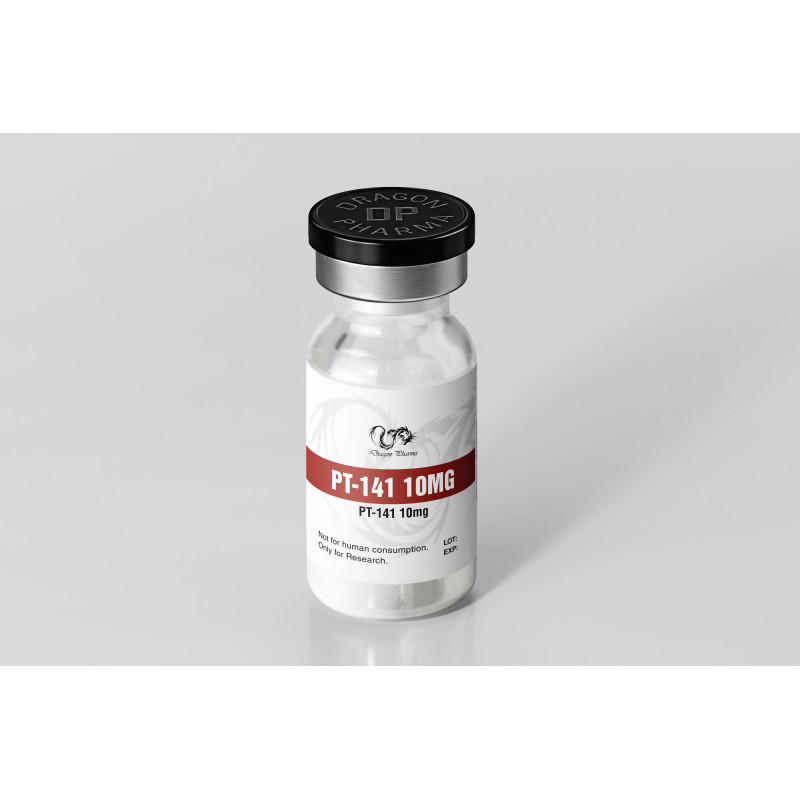
Dragon Pharma PT-141, known generically as Bremelanotide, is a synthetic cyclic heptapeptide and melanocortin receptor agonist derived from Melanotan II. It is one of the most extensively researched peptides in the field of sexual health and arousal science.
Unlike conventional treatments for sexual dysfunction that target blood flow — such as PDE-5 inhibitors like Viagra or Cialis — PT-141 operates through an entirely different pathway. It acts directly on the central nervous system, binding to MC3R and MC4R receptors in the hypothalamus to stimulate the brain's natural arousal and desire circuits.
In 2019, Bremelanotide became the first peptide of its kind to receive FDA approval, marketed under the brand name Vyleesi® for the treatment of hypoactive sexual desire disorder (HSDD) in premenopausal women. Its unique mechanism and clinical validation have made it a reference compound in peptide sexual health research.
Dragon Pharma PT-141 is manufactured to research-grade standards, providing investigators with a reliable and consistent reference compound for laboratory work involving melanocortin receptor signaling.
PT-141's mechanism is what sets it apart from every other compound in its category. Rather than acting peripherally on the vascular system, it targets the neurological root of sexual desire.
PT-141 binds primarily to MC3R and MC4R receptors located in the hypothalamus — the brain region responsible for regulating arousal, motivation, and reproductive behavior. This binding triggers a downstream cascade of neural and hormonal responses associated with sexual interest and readiness.
By activating melanocortin receptors, PT-141 enhances dopamine signaling within the brain's reward and motivation networks. Dopamine is the primary neurotransmitter involved in desire, drive, and anticipatory pleasure — making this mechanism highly relevant to libido research.
Unlike PDE-5 inhibitors, PT-141 does not rely on the nitric oxide–cGMP pathway to produce its effects. Research suggests this makes it potentially useful in cases where traditional ED medications are insufficient, since it bypasses the vascular pathway entirely.
Clinical observations note that effects from subcutaneous administration are typically observable within 30 to 60 minutes, with activity persisting for several hours depending on dose and individual sensitivity.
PT-141 (Bremelanotide) is studied across multiple domains of reproductive and sexual health science:
PT-141 is the active ingredient in FDA-approved Vyleesi®, indicated for hypoactive sexual desire disorder (HSDD) in premenopausal women. Phase 3 RECONNECT trials demonstrated statistically significant improvements in sexual desire scores and reductions in distress compared to placebo, establishing its efficacy profile in this population.
Preclinical and clinical research has explored PT-141 in male subjects. Studies suggest that MC4R activation may upregulate the production of vasodilators within cavernosal tissue, supporting erectile function through a mechanism distinct from PDE-5 inhibition. This makes it of particular research interest for subjects who do not respond adequately to standard ED treatments.
Beyond sexual function, PT-141's selective binding profile at MC3R and MC4R — with comparatively reduced MC1R activity relative to its parent compound Melanotan II — makes it a valuable tool for researchers investigating central melanocortin signaling pathways, energy homeostasis, and neuroendocrine regulation.
PT-141 is frequently used as a reference comparator in studies involving:
Understanding how PT-141 differs from other commonly studied compounds is central to designing meaningful research protocols.
| Feature | PT-141 | PDE-5 Inhibitors |
|---|---|---|
| Primary target | Central nervous system | Vascular system |
| Mechanism | MC3R / MC4R agonism | Nitric oxide / cGMP pathway |
| Effect on desire | Direct stimulation | Indirect (performance-focused) |
| Hormone dependence | None | None |
| Applicability | Low desire + dysfunction | Primarily erectile dysfunction |
The two compound classes are mechanistically complementary. Some research protocols have explored combining a centrally acting melanocortin agonist with a peripherally acting PDE-5 inhibitor to address both desire and physical performance dimensions simultaneously.
PT-141 emerged from Melanotan II research when scientists observed that MT-2 had pronounced effects on sexual arousal during tanning peptide studies. PT-141 was developed as a refined analog with:
Testosterone therapy works systemically by normalizing androgen levels, which can broadly improve energy, mood, and libido over time. PT-141 acts independently of hormone status, making it relevant for on-demand research scenarios where desire circuits are being studied directly, regardless of baseline testosterone levels.
The following information reflects protocols documented in clinical literature and research community reports. All dosing references are for research context only.
PT-141's safety profile is among the best documented of any research peptide, owing to its FDA approval pathway. The following adverse events have been recorded in clinical trials:
| Side Effect | Frequency | Notes |
|---|---|---|
| Nausea | Up to 40% | Most common; typically transient and dose-dependent |
| Flushing | Common | Related to CNS and mild vascular activation |
| Headache | Common | Usually self-resolving |
| Blood pressure increase | Transient | Accompanied by mild heart rate decrease; caution in CV disease |
| Injection site reactions | With SC use | Redness, itching, localized irritation |
| Skin pigmentation changes | Less common | Linked to residual MC1R activity from melanocortin origin |
Note: PT-141 is contraindicated in individuals with uncontrolled hypertension or significant cardiovascular disease due to its transient hemodynamic effects.
| Parameter | Detail |
|---|---|
| Purity | ≥99% (HPLC verified) |
| Form | Lyophilized powder |
| Vial size | 10 mg |
| Peptide sequence | Ac-Nle-cyclo[Asp-His-D-Phe-Arg-Trp-Lys]-OH |
| Structure | Cyclic heptapeptide (lactam bridge) |
| Short-term storage | 2–8°C (up to 7 days reconstituted) |
| Long-term storage | Below -20°C (lyophilized) |
| Usage | Research purposes only |
Dragon Pharma products are manufactured under rigorous quality control standards, with every batch verified for purity and peptide integrity before release.
What makes PT-141 different from Viagra?
Viagra (sildenafil) improves blood flow to genital tissue via the nitric oxide–cGMP pathway and addresses the physical mechanics of erection. PT-141 works in the brain, stimulating melanocortin receptors to directly influence sexual desire and arousal, independently of blood flow. The two mechanisms are complementary rather than competitive.
How long does PT-141 take to work?
Based on clinical data, subcutaneous administration typically produces noticeable effects within 30–60 minutes, with activity lasting several hours depending on dose and individual response.
Does PT-141 cause tanning or skin darkening?
Some users of PT-141 report mild pigmentation changes, as the compound retains partial MC1R activity from its Melanotan II origin. This effect is significantly less pronounced than with MT-2, owing to PT-141's refined receptor selectivity profile.
What is the difference between PT-141 and Melanotan II?
Melanotan II (MT-2) is a broad-acting melanocortin agonist that strongly activates MC1R (responsible for skin tanning) in addition to MC3R/MC4R. PT-141 (Bremelanotide) was developed as a derivative with reduced MC1R activity and stronger emphasis on the MC3R/MC4R pathways that govern arousal, resulting in a more targeted sexual health research profile with less pigmentation activity.
Is PT-141 safe for long-term use?
Long-term safety data is limited. Research protocols involving extended use should be designed accordingly, with appropriate monitoring of hemodynamic parameters.
What is the PT-141 molecular weight?
PT-141 (Bremelanotide) has a molecular weight of 1025.18 g/mol and a molecular formula of C50H68N14O10. Its CAS number is 189691-06-3.