Quantity
Total
Total products
Total shipping To be determined
Total

 +
+ 
Out Stock This product is no longer in stock
Warning: Last items in stock!
Availability date:
Brand: Dragon Pharma
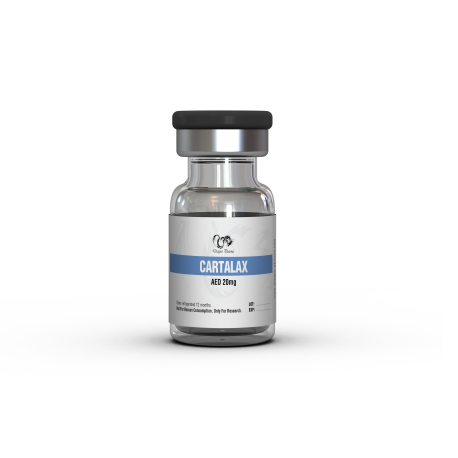
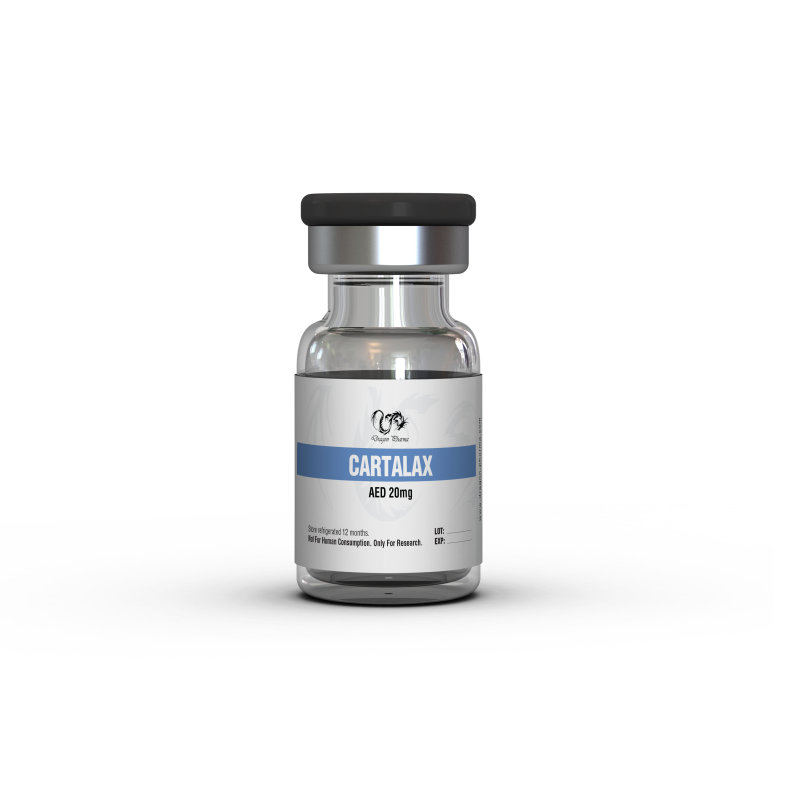
Cartalax (AED Peptide) is a synthetic tripeptide composed of the amino acids alanine, glutamic acid, and aspartic acid (Ala-Glu-Asp). It belongs to a class of short peptide bioregulators that have been investigated in laboratory research involving cartilage biology, connective tissue, and cellular physiology.
| Property | Value |
|---|---|
| Brand | Dragon Pharma |
| Peptide Name | Cartalax |
| Peptide Sequence | Ala-Glu-Asp |
| Molecular Formula | C12H19N3O8 |
| Molecular Weight | 333.29 g/mol |
| Synonyms | AED Peptide, T-31 Peptide, Alanyl-Glutamyl-Aspartic Acid |
Cartalax is a low-molecular-weight synthetic tripeptide designed for laboratory investigation. Its compact structure has made it a subject of research into peptide signaling, gene regulation, and cellular communication.
Experimental studies have examined its interactions with chondrocytes, fibroblasts, and other connective tissue cells involved in extracellular matrix maintenance. Research has also explored its relationship with collagen metabolism, cartilage homeostasis, and cellular renewal processes.
The peptide's stability and defined amino acid sequence make it suitable for controlled laboratory studies investigating peptide bioregulators and tissue biology.
Current research suggests that Cartalax may influence multiple biological pathways involved in connective tissue physiology. Experimental investigations have focused on its potential interaction with:
These proposed mechanisms continue to be investigated in preclinical and laboratory settings, and additional research is needed to better understand their biological significance.
Research has explored Cartalax's interaction with cartilage tissue, particularly its relationship with chondrocyte function, extracellular matrix regulation, and cartilage homeostasis.
Laboratory studies have examined its influence on fibroblast activity, collagen-related pathways, and extracellular matrix remodeling involved in connective tissue biology.
Experimental models have investigated Cartalax in relation to cellular senescence, gene regulation, apoptosis, and molecular pathways associated with healthy aging research.
Researchers have studied Cartalax in areas involving tissue regeneration, cellular communication, and stem cell biology to better understand peptide-mediated signaling mechanisms.
Published studies have also investigated Cartalax in connection with:
Cartalax is supplied as a lyophilized (freeze-dried) peptide. Lyophilization helps preserve peptide integrity and stability during storage by reducing moisture content.
This preparation method is widely used for research peptides because it supports long-term stability prior to reconstitution when stored under appropriate laboratory conditions.
Store the lyophilized peptide in accordance with the manufacturer's recommendations. Protect the product from excessive heat, moisture, and direct sunlight, and keep the container tightly sealed when not in use.
For laboratory work, use appropriate handling procedures and suitable storage conditions to help maintain sample integrity.
Dragon Pharma manufactures research products with an emphasis on product consistency and standardized production practices. Product identity, composition, and batch consistency are important considerations for research materials used in laboratory environments.
Researchers should always verify product specifications and follow applicable laboratory protocols before use.
Dragon Pharma Cartalax provides researchers with a synthetic tripeptide that has been investigated in studies involving cartilage biology, connective tissue, extracellular matrix regulation, and cellular aging.
Key features include:
Cartalax (AED peptide) has been described in peer-reviewed scientific literature investigating topics such as cartilage biology, extracellular matrix regulation, fibroblast function, cellular aging, stem cell biology, regenerative medicine, and peptide bioregulators. Readers interested in the underlying evidence should consult the cited publications for detailed methodology and study findings.