July 7, 2026 · 7 min read
Thymosin Beta 4 (TB-500): A Complete Guide to Research and Potential Benefits
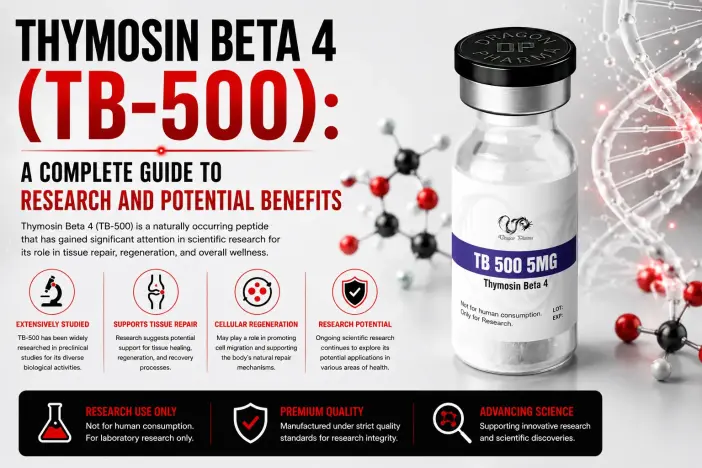
The landscape of regenerative medicine is shifting rapidly toward cellular and peptide-based therapies. Among the molecules attracting significant attention from the scientific community, Thymosin Beta-4 (Tβ4) and the TB-500 peptide, a synthetic version derived from the naturally occurring protein, stand out. Researchers across the globe are actively investigating the TB-500 peptide to better understand its potential role in tissue repair, cellular mobility, inflammation modulation, and systemic wound healing. As interest in peptide-based research continues to grow, TB-500 has become a focal point in studies exploring regenerative mechanisms and recovery processes.
This comprehensive scientific guide explores the structural architecture, biological mechanisms, and potential therapeutic benefits of Thymosin Beta-4 and TB-500 based on the latest laboratory and clinical insights.
What is Thymosin Beta-4?
Thymosin Beta-4 is a naturally occurring peptide comprised of 43 amino acids. Encoded by the TMSB4X gene, it is the most abundant member of the beta-thymosin family in human tissues. Unlike localized signaling molecules, Thymosin Beta-4 is highly conserved across species and is found in high concentrations in almost every cell type, particularly within blood platelets, white blood cells, and tissues undergoing active repair.
As interest in peptides for sale continues to grow among researchers and laboratories, Thymosin Beta-4 has emerged as one of the most widely studied peptides due to its potential involvement in cell migration, tissue regeneration, wound healing, and inflammatory response. Its broad biological activity has made it a valuable subject in regenerative medicine and peptide research, although its applications remain an active area of scientific investigation.
The Natural Role of Thymosin Beta-4 in Cellular Homeostasis
The primary physiological responsibility of Thymosin Beta-4 is the regulation of actin, a major structural protein essential for cellular cytoskeleton. By binding to G-actin (monomeric actin), Tβ4 acts as a major actin-sequestering molecule. This interaction prevents action from polymerizing into F-actin (filamentous actin), keeping a pool of monomers available for rapid filament assembly.
This precise control over the cellular framework allows cells to:
- Dynamically change their shape.
- Migrate across extracellular matrices toward injury sites.
- Engage in effective intracellular transport and signaling.
Beyond its structural duties, Thymosin Beta-4 acts as an up-regulated signaling molecule during trauma, coordinating cellular survival and tissue protection.
What is TB-500?
While Thymosin Beta-4 refers to the full-length, naturally occurring 43-amino-acid peptide, TB-500 is a synthetic research peptide engineered to replicate the active domain of Tβ4. Specifically, TB-500 often corresponds to the central segment of the Tβ4 molecule (the 17-23 amino acid fragment, known as LKKTETQ). This specific sequence is identified as the core region responsible for actin binding, cell migration, and tissue regeneration.
Thymosin Beta-4 vs. TB-500: A Comparative Overview
|
Feature |
Thymosin Beta-4 (Tβ4) |
TB-500 |
|
Origin |
Endogenously produced in human and animal tissues. |
Synthetically manufactured via solid-phase peptide synthesis. |
|
Molecular Structure |
Full-length sequence of 43 amino acids. |
Typically an active fragment or synthetic analog of the main sequence. |
|
Primary Use Profile |
Natural physiological maintenance and clinical therapeutic research. |
Targeted laboratory experimentation and preclinical models. |
|
Molecular Weight |
Approximately 4.9 kDa. |
Lower molecular weight due to fragment design, facilitating tissue penetration. |
|
Focus of Investigation |
Systemic healing, internal organ repair, and fundamental cellular biology. |
Accelerated localized tissue repair, performance-related injury recovery, and angiogenesis. |
Cellular Mechanisms: How It Works
To understand the impact of these peptides, one must examine the cascading steps the body takes following an injury. When cellular damage occurs, a complex biological symphony is triggered. Tβ4 and TB-500 act as molecular conductors in this process through several defined pathways:
1. Acceleration of Cell Migration (Chemotaxis)
Before tissue can be rebuilt, specialized repair cells (such as fibroblasts, endothelial cells, and keratinocytes) must travel to the epicenter of the injury. Research demonstrates that Tβ4 upregulates matrix metalloproteinases (MMPs) enzymes that temporarily degrade the surrounding extracellular matrix, clearing a path for repair cells to migrate quickly to the damaged area.
2. Angiogenesis and Vascular Remodeling
Healing requires blood flow to deliver oxygen and essential nutrients. Tβ4 stimulates angiogenesis the sprouting of new blood vessels from pre-existing ones. It achieves this by promoting the migration and differentiation of endothelial cells, alongside upregulating vascular endothelial growth factor (VEGF) expressions.
3. Downregulation of Pro-Inflammatory Cytokines
While initial inflammation is vital for clearing pathogens, prolonged chronic inflammation creates scar tissue and halts recovery. Preclinical data indicates that Tβ4 helps modulate the inflammatory cascade by decreasing the expression of major pro-inflammatory cytokines, such as Tumor Necrosis Factor-alpha (TNF-) and Interleukin-1 beta (IL-1$\beta$), while favoring a balanced, regenerative cellular environment.
Deep Dive: Key Research Benefits of Thymosin Beta-4 and TB-500
Driven by these underlying mechanisms, scientists have uncovered several specific applications where these peptides influence regenerative outcomes.
1. Accelerated Wound Healing and Dermal Repair
In skin injury models, Tβ4 significantly shortens the time required for wound closure. It accelerates the re-epithelialization phase by encouraging keratinocytes to move across the wound bed. This property makes it a major focus in research targeting non-healing dermal ulcers and deep tissue burns.
2. Skeletal Muscle Regeneration
Following high-intensity strain or mechanical trauma, muscle fibers exhibit microscopic tears. Studies indicate that TB-500 aids muscle recovery by activating satellite cells the precursor stem cells responsible for generating new muscle tissue. This results in faster structural restoration of the myofibrils.
3. Tendon Remodeling
Tendons are notorious for healing slowly due to their low vascularity and dense collagen matrix. Research demonstrates that TB-500 encourages the proliferation of tenocytes (tendon cells) and enhances the synthesis of type I and type III collagen, helping restore the biomechanical tensile strength of the tissue.
4. Ligament Support
Like tendons, ligaments undergo prolonged healing cycles post-injury. In animal models of ligament tears, administration of Tβ4 has shown an increase in cellular density and improved structural alignment of the newly deposited fibers, preventing poor tissue remodeling and long-term joint laxity.
5. Joint and Cartilage Optimization
Cartilage lacks a direct blood supply, limiting its self-repair capabilities. Advanced laboratory evaluations suggest that Tβ4 may help support chondrocyte (cartilage cell) survival and stimulate extracellular matrix production, presenting potential avenues for joint health exploration.
6. Enhanced Post-Injury Flexibility
When tissues heal poorly, they often form stiff, unyielding scar tissue (fibrosis). By optimizing the ratio of collagen deposition and reducing prolonged inflammation, Tβ4 and TB-500 help the tissue retain its natural elasticity, directly correlating to better flexibility and movement ranges post-recovery.
7. Corneal Re-Epithelialization
The surface of the eye is highly sensitive to erosion and chemical injuries. Tβ4 has been extensively researched in ophthalmology for its ability to promote corneal epithelial cell migration, suppress ocular inflammation, and prevent clarity-robbing scarring on the ocular surface.
8. Myocardial and Cardio protection Research
One of the most profound discoveries in regenerative biology is Tβ4's impact on cardiac tissue. Following hypoxic stress or ischemic injury (such as a heart attack model), preclinical research indicates that Tβ4 activates dormant epicardial progenitor cells, supporting the preservation and potential repair of surrounding heart tissue while mitigating scar formation.
9. Neuroprotection and Nerve Regeneration
The central and peripheral nervous systems have limited regenerative capacities. Emerging studies suggest Tβ4 promotes oligodendrocyte differentiation, which is crucial for maintaining the protective myelin sheath around nerves. It also supports axonal sprouting and neuroprotection in models of neurological trauma.
10. Systemic Tissue Architecture Maintenance
Because Tβ4 operates on a fundamental cellular level via actin regulation, its potential benefits are not confined to a single organ system. It plays an ongoing role in systemic cellular maintenance, ensuring that the structural integrity of internal organs, blood vessels, and mucosal linings remain stable.
Future Horizon in Peptide Research
The exploration of Thymosin Beta-4 and TB-500 represents a cornerstone of modern peptide science. As synthesis technologies advance and our understanding of cellular signaling deepens, these molecules remain at the forefront of research aimed at transitioning medicine from passive symptom management to active tissue regeneration. With growing interest from research institutions and laboratories, many professionals also seek reliable sources to buy peptides online for legitimate scientific and experimental purposes. However, it is essential to obtain research peptides from reputable suppliers that prioritize quality standards, purity testing, and transparent documentation to support credible research outcomes.