
July 7, 2026 · 11 min read
Semax Peptide: A Comprehensive Overview of Its Scientific Research Potential
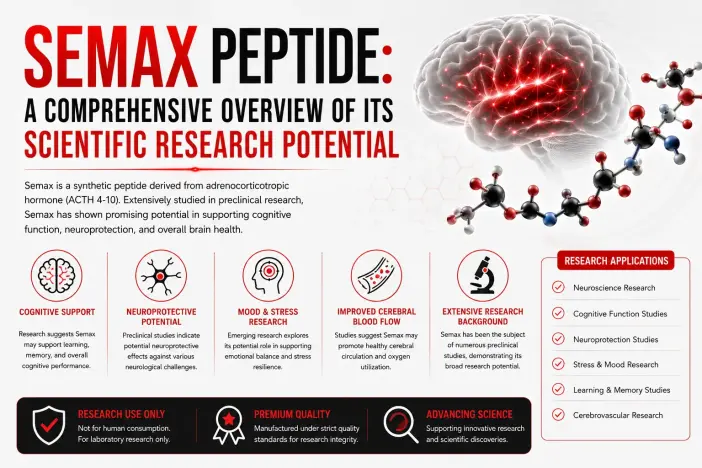
Interest in brain health, cognitive performance, stress adaptation, and neurobiology continues to grow as researchers explore the complex systems that influence learning, memory, mood, and neuronal resilience. Among the many compounds being investigated in peptide science, the Semax peptide has attracted attention for its potential role in neuroscience and cognitive research.
Semax is a synthetic peptide derived from adrenocorticotropic hormone (ACTH). It is being studied for its possible influence on neurotrophic factors, neurotransmitter signaling, stress-response pathways, and cellular mechanisms involved in neural adaptability. Researchers are particularly interested in Semax because it may interact with several biological systems connected to learning, memory, emotional regulation, neuroprotection, and brain-immune communication.
While Semax research is still evolving, its broad range of proposed mechanisms makes it a notable subject in neurobiology, nootropic research, stress-response studies, and regenerative science.
What Is Semax Peptide?
Semax is a synthetic heptapeptide, meaning it is composed of seven amino acids. It was developed as an analogue of a short fragment of adrenocorticotropic hormone, commonly known as ACTH.
Unlike ACTH itself, Semax is primarily studied for its neuroactive properties rather than its role in adrenal hormone signaling. Its structure has made it an interesting candidate for researchers investigating how peptides may influence communication between neurons, neurotrophic activity, neurotransmitter systems, and stress-related biological pathways.
The Semax peptide is not simply researched as a stimulant or cognitive enhancer. Instead, scientists are interested in its potential influence on the molecular systems that help the brain adapt to internal and external stressors. These include synaptic communication, neuronal signaling, neuroplasticity, oxidative stress responses, and neurotrophic factor regulation.
Because of these proposed mechanisms, Semax has become relevant in studies involving cognitive function, memory, stress adaptation, neuroprotection, immune signaling, sleep biology, and metabolic regulation.
How Does Semax Work?
Semax is being investigated for its possible effects on several signaling pathways in the brain and body. While research findings remain under development, preclinical studies suggest that Semax may influence neurotrophic factors, neurotransmitter activity, receptor signaling, and stress-response mechanisms.
Possible Influence on Neurotrophic Factors
One of the most discussed areas of Semax research involves neurotrophic factors, particularly brain-derived neurotrophic factors, also known as BDNF.
Neurotrophic factors are proteins that support neuronal growth, survival, communication, and adaptation. They are important for maintaining healthy neural networks and supporting synaptic plasticity, which refers to the brain's ability to strengthen, weaken, or reorganize connections between neurons.
Research suggests that Semax may influence BDNF-related signaling. This has made the peptide an area of interest for scientists studying neuronal resilience, neural adaptability, learning processes, and brain aging models.
Possible Interaction with Neurotransmitter Systems
Semax is also being studied for its potential interaction with major neurotransmitter systems. Neurotransmitters are chemical messengers that help neurons communicate with one another.
Research has explored Semax in relation to dopamine, serotonin, acetylcholine, and related signaling pathways. These neurotransmitters are involved in many functions, including motivation, reward processing, attention, emotional regulation, learning, memory formation, and behavioral adaptation.
The proposed relationship between Semax and neurotransmitter activity is one reason it remains relevant in cognitive science and behavioral neuroscience research.
AMPA and NMDA Receptor Research
Semax may also be relevant to research involving AMPA and NMDA receptors. These receptors are part of the glutamate signaling system and play important roles in synaptic communication, learning, and memory formation.
AMPA receptors help support fast excitatory signaling between neurons, while NMDA receptors are involved in synaptic strengthening and long-term changes in neural connections. Because these processes are closely linked with memory encoding and neuroplasticity, Semax is being investigated as a possible tool for studying how peptides may influence learning-related pathways.
Potential Role in the HPA Axis
Another important area of Semax research involves the hypothalamic-pituitary-adrenal axis, often called the HPA axis. The HPA axis is the body's central stress-response system. It helps coordinate hormonal and neurological responses to physical and psychological stressors. Researchers are investigating whether Semax may influence cortisol signaling, stress feedback mechanisms, and the biological processes involved in adaptation to challenging conditions. This proposed activity makes Semax relevant to stress-response research, oxidative stress studies, and investigations into cellular resilience.
Potential Benefits of Semax Peptide in Scientific Research
The potential benefits of Semax should be understood as areas of scientific investigation rather than established outcomes. Much of the available research is preclinical, mechanistic, or exploration in nature.
Supports Cognitive Function and Focus Research
Semax is being studied for its possible role in cognitive function, attention, learning processes, and mental processing. Researchers are interested in how peptide may influence synaptic communication and neuroplasticity, both of which are essential for how the brain processes and stores information.
Cognitive function includes a wide range of mental processes, such as attention, working memory, problem-solving, learning, and information retention. Semax is being explored because of its possible relationship with neurotrophic factors and neurotransmitter systems that contribute to these processes.
Research into Semax may help scientists better understand how neuronal communication supports mental clarity, attention, and adaptive learning. However, current findings should not be interpreted as proof that Semax directly improves intelligence or guarantees enhanced cognitive performance.
Supports Memory and Learning Research
Memory formation depends on coordinated activity across multiple brain systems. Semax is being researched for its potential involvement in pathways related to synaptic plasticity, acetylcholine signaling, AMPA receptors, NMDA receptors, and neural communication.
Synaptic plasticity allows neurons to modify their connections based on experience. This process is central to learning, memory encoding, memory retrieval, and cognitive adaptability. Researchers are investigating whether Semax may influence the molecular mechanisms that support these changes.
Acetylcholine signaling is also important in memory research. Cholinergic neurons help regulate attention, learning, and memory-related processes. By studying Semax in relation to acetylcholine activity, scientists may gain additional insight into the biological pathways involved in information processing and retention.
Supports Stress Response and Adaptation Research
Stress is a biological process that involves the brain, endocrine system, immune system, and metabolic pathways. Semax is being explored for its possible influence on the HPA axis, cortisol signaling, and feedback regulation involved in the body's response to stress.
The HPA axis helps coordinate how the body responds to physical and psychological stressors. Researchers are studying whether Semax may affect the mechanisms that regulate stress adaptation and help cells respond to challenging environments.
Semax is also being investigated in oxidative stress research. Oxidative stress occurs when there is an imbalance between reactive molecules and the body's antioxidant defenses. Scientists are interested in whether Semax-related pathways may provide insight into cellular resilience and how neural tissues respond to oxidative challenges.
Supports Neuroprotection and Brain Health Research
Neuroprotection research focuses on understanding how neurons maintain function and resilience under difficult conditions. Semax is being studied because of its proposed relationship with neurotrophic factors, neuronal survival pathways, and cellular protection mechanisms.
Researchers are investigating whether Semax may influence processes related to neuronal resilience, excitotoxicity, oxidative stress, and neural repair pathways. Excitotoxicity refers to excessive stimulation of certain receptors, which can place stress on neurons and is commonly examined in neurodegenerative research models.
Semax is also relevant to studies involving brain aging and neurodegenerative models. These studies aim to understand how neurons resist damage, maintain communication, and preserve function over time. Much of this work remains preclinical and is focused on biological mechanisms rather than confirmed medical outcomes.
Supports Neurotransmitter Signaling Research
Neurotransmitters influence cognition, motivation, emotional regulation, behavior, and reward processing. Semax is being researched for its possible interaction with several major neurotransmitter systems.
Dopamine-related signaling is important in motivation, reward, attention, and goal-directed behavior. Serotonin is closely connected with emotional regulation, behavioral responses, and sleep-wake signaling. Acetylcholine plays a central role in attention, learning, and memory-related communication.
By investigating Semax in relation to these neurotransmitter systems, researchers may better understand the biochemical foundations of behavior, focus, cognition, and neural adaptability. This makes Semax a subject of interest in behavioral neuroscience, cognitive science, and nootropic research.
Supports Immune and Neuroinflammation Research
The relationship between the nervous system and immune system is an expanding area of scientific research. Semax is being investigated for possible immunomodulatory activity, particularly in relation to cytokine signaling, inflammatory responses, oxidative stress, and neuroinflammation.
Cytokines are signaling molecules that help regulate immune activity. Inflammatory processes can also influence neural health, especially when researchers study communication between immune cells and the nervous system.
Scientists are exploring whether Semax may influence inflammatory pathways connected with neural signaling and cellular resilience. This remains an emerging area of research, and further studies are needed to clarify the peptide's possible role in brain-immune communication.
Supports Sleep and Circadian Rhythm Research
Sleep and circadian rhythms are regulated by complex interactions between neurotransmitters, hormones, environmental cues, and brain signaling pathways. Semax is being explored as a possible research tool in studies of sleep-wake regulation and circadian biology.
Dopamine and serotonin pathways are closely linked with sleep, alertness, mood, and biological rhythms. Researchers are interested in whether Semax-related signaling may offer insight into how these systems influence sleep-wake cycles.
Semax may also be relevant to melatonin-related research and studies of how molecular cues help synchronize the body's internal clock. This remains an early research area requiring further investigation.
Supports Metabolic and Energy Balance Research
Semax is also being studied in relation to metabolic signaling and energy balance. The hypothalamus plays a major role in regulating appetite, energy use, hormonal signaling, and glucose metabolism.
Researchers are investigating whether Semax may influence hypothalamic pathways connected with appetite regulation, energy balance, glucose metabolism, and insulin sensitivity. These studies may help expand understanding of the relationship between the nervous system and metabolic processes.
Current research should not be interpreted as support for weight-management or metabolic treatment claims. Instead, Semax remains a subject of interest for researchers studying how neural and metabolic systems communicate.
Who May Be Interested in Semax Research?
Semax research may be of interest to several scientific and educational communities. Neuroscience researchers may study Semax to explore cognitive function, neuroplasticity, neurotrophic factors, and neuronal signaling. Researchers focused on memory and learning may be interested in its proposed relationship with synaptic plasticity, AMPA receptors, NMDA receptors, and acetylcholine activity.
Scientists studying stress adaptation may examine Semax in connection with the HPA axis, cortisol signaling, oxidative stress, and cellular resilience. Researchers interested in neuroprotection may explore its potential relevance to neuronal survival pathways, neural repair mechanisms, and neurodegenerative research models.
Semax may also be relevant to peptide research communities, behavioral scientists, nootropic researchers, and scientists studying neuroinflammation, brain-immune communication, sleep biology, circadian rhythms, and metabolic signaling.
Scientific Research and Evidence
The current evidence base for Semax includes laboratory research, animal studies, mechanistic investigations, and a smaller body of human research. While the peptide has generated scientific interest, its biological effects and future research applications require continued study.
Preclinical Research
Much of the available Semax research comes from laboratory experiments, animal studies, and mechanistic research. Common themes include neurotrophic factors such as BDNF, synaptic plasticity, memory and learning models, neurotransmitter systems, stress-response pathways, oxidative stress, neuroprotection models, and immune signaling.
Preclinical research is valuable because it helps scientists identify possible molecular mechanisms and biological pathways. However, findings from laboratory or animal models do not automatically translate into established human outcomes.
Human Research
Human research involving Semax exists but remains limited compared with the broader body of preclinical and mechanistic research. Additional well-designed clinical studies are needed to clarify its biological effects, long-term implications, and possible role in future neuroscience research.
Researchers will need more data to better understand how Semax interacts with human neurobiology, stress-response systems, immune signaling, and cognitive processes.
Research Limitations
Scientific findings related to Semax continue to evolve. While early and pre-clinical research may be promising, results should be interpreted carefully.
Research models can provide useful insight into biological mechanisms, but they cannot confirm established outcomes in humans without further clinical investigation. Semax remains an active area of study in neurobiology, cognitive science, stress-response research, and peptide science.
Conclusion
Semax is a synthetic ACTH-derived peptide that is being studied for its neuroactive properties and potential influence on several biological systems. Researchers are investigating its possible relationship with neurotrophic factors, neurotransmitter signaling, cognitive function, stress adaptation, neuronal resilience, immune signaling, sleep biology, and metabolic regulation.
Its proposed connection with BDNF, synaptic plasticity, dopamine, serotonin, acetylcholine, AMPA receptors, NMDA receptors, and the HPA axis makes Semax relevant to multiple areas of neuroscience research.
From memory and focus research to neuroprotection, neuroinflammation, stress adaptation, and circadian biology, Semax has become a notable topic in peptide science. However, it should be viewed as a subject of ongoing scientific investigation rather than an established medical solution.
For readers exploring research compounds and peptide science, Dragon Pharma Peptides offers access to a range of peptide research products. Explore the Semax peptide listing and broader peptide collection through Dragon Pharma for research-focused product information.