July 15, 2026 · 8 min read
GHK Basic Peptide: An Overview of Synthesis and Research Applications
Peptides have become an important area of investigation in modern biomedical science due to their ability to act as signaling molecules within biological systems. These short chains of amino acids can influence cellular communication, tissue organization, immune responses, and repair-related processes. As researchers continue exploring regenerative biology, peptides have gained attention for their potential applications in areas such as molecular biology, biotechnology, skincare science, and tissue engineering.
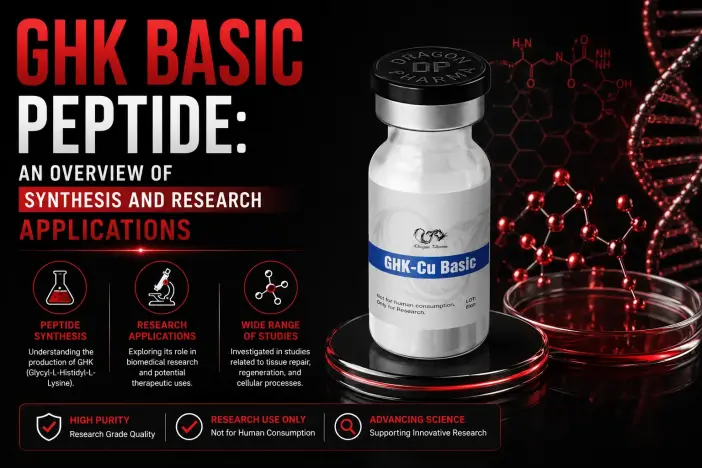
One peptide that has attracted significant scientific interest is GHK peptide, also known as Glycyl-L-Histidyl-L-Lysine. This naturally occurring tripeptide has been studied for decades because of its relationship with cellular repair mechanisms, extracellular matrix regulation, inflammation pathways, and oxidative stress responses.
GHK is particularly well known for its ability to bind copper ions, forming the GHK-Cu peptide complex. This copper-binding form has been widely investigated in regenerative research because copper plays an important role in biological processes, including enzyme activity, antioxidant defense systems, and connective tissue formation.
Research into GHK peptide has explored its possible involvement in:
- Cellular signaling pathways
- Collagen-related processes
- Tissue remodeling
- Inflammatory regulation
- Oxidative stress response mechanisms
- Cellular aging research
However, it is important to understand that much of the current evidence surrounding the GHK-Cu peptide comes from laboratory studies and preclinical research. While findings have provided valuable insights into its possible biological functions, further human research is needed to fully understand the role of the GHK-Cu peptide in medical and therapeutic applications.
What Is GHK Peptide?
GHK stands for Glycyl-L-Histidyl-L-Lysine, a naturally occurring tripeptide composed of three amino acids:
- Glycine
- Histidine
- Lysine
As a tripeptide, GHK belongs to a class of small peptide molecules that can function as biological messengers. Unlike larger proteins, peptides are shorter chains of amino acids that may interact with specific cellular pathways. GHK was first identified in human plasma, where researchers observed that its levels changed with age. This discovery contributed to scientific interest in understanding whether GHK plays a role in biological maintenance and repair processes.
Where Is GHK Found Naturally?
GHK naturally exists in the human body and has been detected in biological fluids and tissues.
Research has identified GHK in areas such as:
- Blood plasma
- Extracellular environments
- Tissue-related biological systems
Scientists have investigated the possibility that GHK functions as a signaling molecule involved in maintaining communication between cells and their surrounding environment.
Studies have suggested that GHK levels may change during aging, which has contributed to research exploring its relationship with:
- Tissue maintenance
- Cellular communication
- Regenerative biology
GHK and Copper: Understanding the GHK-Cu Complex
One of the most researched aspects of GHK peptide is its ability to bind copper ions. When GHK binds copper, it forms the complex known as:
GHK-Cu peptide
Copper is an essential mineral involved in many biological processes, including:
- Enzyme function
- Antioxidant defense systems
- Connective tissue formation
- Cellular metabolism
The GHK-Cu complex has become a major focus of regenerative science research because copper-dependent enzymes are involved in processes related to extracellular matrix organization and tissue structure.
Researchers have investigated GHK-Cu for its potential influence on:
- Collagen-related pathways
- Skin remodeling processes
- Wound repair mechanisms
- Cellular signaling networks
It is important to note that these findings mainly come from experimental research, and GHK-Cu is not established as a universal medical treatment.
Why GHK-Cu Is Studied in Regenerative Research
Regenerative science focuses on understanding how biological systems maintain, repair, and rebuild tissues.
GHK-Cu has gained attention because researchers believe it may interact with several biological processes involved in tissue organization.
Areas of investigation include:
- Extracellular matrix remodeling
- Fibroblast activity
- Collagen synthesis pathways
- Cellular communication
- Oxidative stress response
Because connective tissue changes are associated with aging and injury, GHK-Cu has become a subject of interest in fields including biotechnology, cosmetic science, and regenerative medicine research.
GHK Peptide Synthesis and Molecular Structure
Peptide synthesis is the laboratory process used to create specific peptide sequences by connecting amino acids in a controlled order.
Modern peptide synthesis research allows scientists to produce peptides that are:
- Structurally defined
- Chemically characterized
- Tested in controlled experiments
Synthetic production enables researchers to investigate how specific peptide structures interact with biological systems.
How Synthetic GHK Peptide Is Produced
Laboratory production of GHK typically involves chemical peptide synthesis techniques.
A simplified overview includes:
- Selection of the required amino acids
- Sequential linking of amino acids into the correct order
- Removal of protective chemical groups
- Purification of the final peptide
- Structural confirmation and quality testing
Because peptide research depends on accurate molecular structures, scientists carefully analyze:
- Purity
- Stability
- Chemical identity
- Biological activity
These quality factors are essential when studying peptides in laboratory environments.
Molecular Structure of GHK
The GHK peptide sequence consists of three amino acids:
Glycine
Glycine is the smallest amino acid and contributes flexibility to peptide structures. It is also an important component of collagen, the structural protein that provides strength and organization to connective tissues.
Histidine
Histidine contains a chemical structure that allows it to interact with metal ions, including copper. This property contributes to GHK's ability to form the GHK-Cu complex.
Lysine
Lysine is an amino acid involved in protein structure and modification processes. Within collagen biology, lysine contributes to cross-linking processes that help provide structural stability. Together, these three amino acids create a peptide sequence capable of interacting with biological systems.
Importance of Purity and Characterization in Peptide Research
Accurate scientific investigation requires carefully characterized peptide materials.
Researchers evaluate factors such as:
- Molecular structure
- Purity percentage
- Stability under different conditions
- Interaction with biological targets
Poorly characterized peptide materials can make research findings difficult to interpret. For this reason, peptide synthesis research places significant importance on analytical testing and standardized preparation methods.
How GHK Interacts with Biological Pathways
Researchers continue studying GHK peptide because of its possible influence on multiple cellular pathways.
The proposed mechanisms involve several areas:
- Cellular signaling
- Extracellular matrix remodeling
- Gene expression regulation
- Tissue regeneration pathways
Cellular Signaling Research
Cells communicate through complex networks of signals that regulate growth, repair, and adaptation.
Studies investigating GHK have explored whether it may influence cellular communication pathways involved in:
- Cell activity
- Tissue organization
- Repair signaling
Researchers use laboratory models to examine how GHK interacts with cells and molecular pathways.
Extracellular Matrix Remodeling
The extracellular matrix provides structural support around cells.
It contains important components such as:
- Collagen
- Elastin
- Proteoglycans
Research suggests GHK-Cu may influence processes related to extracellular matrix remodeling, which is important for maintaining tissue structure.
Collagen-Related Pathways
Collagen synthesis and organization are major areas of interest in GHK research.
Studies have investigated whether GHK-Cu may affect:
- Fibroblast activity
- Collagen-related gene expression
- Extracellular matrix organization
Because collagen plays an important role in skin and connective tissue structure, GHK-Cu has become a commonly studied collagen synthesis peptide in cosmetic and regenerative research.
Conclusion
Peptides for Sale continue to attract growing interest among researchers, with the GHK peptide standing out as an important subject of investigation within peptide science, regenerative research, and molecular biology. Its unique ability to interact with biological pathways involved in tissue organization, cellular communication, inflammation regulation, and oxidative stress response has made it a valuable research compound. As a naturally occurring tripeptide composed of glycine, histidine, and lysine, GHK provides researchers with valuable insights into how small signaling molecules may influence complex cellular processes.
A major area of interest is the GHK-Cu peptide complex, which combines GHK with copper, an essential element involved in numerous biological functions. Research suggests that GHK-Cu may interact with pathways related to extracellular matrix remodeling, collagen-related processes, antioxidant defense systems, and cellular repair mechanisms. These findings have contributed to growing interest in GHK as one of the widely studied regenerative peptides in biotechnology, skincare science, and tissue research.
Current studies have provided promising insights into how GHK may influence inflammation-related signaling, oxidative stress pathways, and tissue regeneration processes. Laboratory and preclinical research has explored its potential relationship with factors such as cellular communication, collagen synthesis, antioxidant activity, and gene expression regulation. However, these findings should be interpreted within the context of scientific research, as many discoveries remain based on experimental models rather than large-scale human clinical studies.
The field of peptide science continues to evolve, and GHK research represents an example of how naturally occurring molecules can help researchers better understand biological repair and aging-related processes. Future investigations will be important for clarifying how GHK and GHK-Cu function in different biological environments and how these mechanisms may translate into practical applications.
Those looking to Buy Dragon Pharma research products should understand that GHK peptide remains a promising research molecule rather than an established medical solution. Continued scientific study, improved understanding of molecular pathways, and well-designed clinical research will help determine the full potential of GHK in regenerative medicine, tissue engineering, and cellular health research.