July 7, 2026 · 6 min read
Understanding TB-500 Peptide: Research and Scientific Perspectives
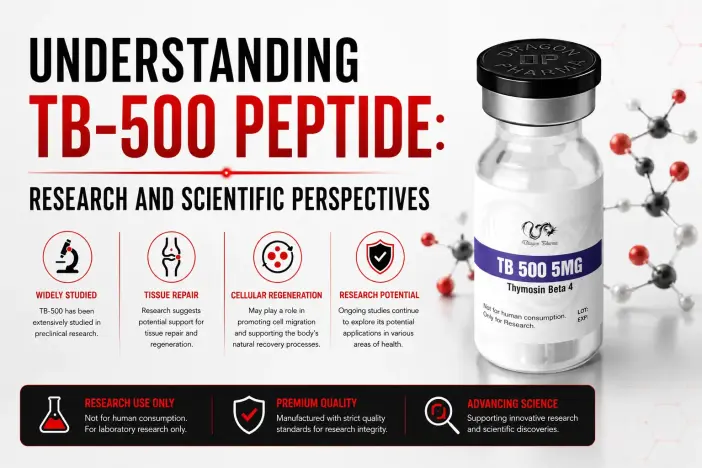
The TB-500 peptide has gained significant attention in modern biochemical and regenerative medicine research due to its association with tissue repair pathways and cellular regeneration processes. It is widely discussed in scientific literature as a synthetic fragment related to Thymosin Beta-4, a naturally occurring protein found in many tissues of the human body.
In the field of peptide science research, TB-500 is frequently studied for its potential involvement in processes such as cell migration, inflammation regulation, and vascular development. These biological functions make it a topic of interest in experimental studies exploring how cells respond to injury and repair signals.
Importantly, TB-500 is not a naturally occurring hormone, but a laboratory-synthesized peptide used primarily in controlled research environments. While researchers frequently look to buy peptides online to conduct these scientific investigations, its study is strictly intended to help scientists better understand complex regenerative pathways rather than serving as an established therapeutic agent.
This article provides a structured, evidence-based overview of:
- What TB-500 peptide is
- How it functions at a molecular level
- Its role in preclinical and scientific research
- Its relationship to Thymosin Beta-4
- Current knowledge gaps in regenerative biology
What is TB-500 Peptide?
The TB-500 peptide is a synthetic peptide fragment derived from the sequence of Thymosin Beta-4, a 43-amino-acid protein naturally present in nearly all human tissues.
Scientific Classification
TB-500 is classified as a:
- Synthetic peptide fragment
- Research-grade biomolecule
- Experimental model compound in regenerative biology studies
Relationship to Thymosin Beta-4
TB-500 is often discussed alongside Thymosin Beta-4 because it mimics certain structural or functional aspects of the full protein. However, it does not represent the complete biological molecule.
Why It Is Used in Research
Researchers study TB-500 to better understand:
- Cellular repair signaling pathways
- Tissue regeneration mechanisms
- Cytoskeletal dynamics
- Angiogenic responses
Its simplified structure allows controlled experimentation on specific biological functions.
Molecular Structure and Biological Mechanism
TB-500 is studied primarily for its potential interactions with actin, a key structural protein inside cells.
Actin-Binding Properties
Actin is responsible for maintaining cell shape and enabling movement. Research suggests TB-500 may influence actin dynamics indirectly through pathways associated with Thymosin Beta-4 activity.
Cell Migration Mechanisms
Cell migration is essential for tissue repair. Studies indicate TB-500-related pathways may support:
- Movement of epithelial cells
- Migration of endothelial cells
- Organization of repair sites
Angiogenesis (New Blood Vessel Formation)
Angiogenesis is the process of forming new blood vessels from existing ones. Preclinical research suggests TB-500 may be associated with signaling pathways involved in vascular development.
Inflammation Modulation
Inflammation is a key early response in tissue injury. TB-500-related mechanisms are studied for their potential role in balancing inflammatory signaling during repair processes.
Tissue Remodeling Pathways
Tissue remodeling involves structural reorganization of damaged tissue. TB-500 is investigated for its potential involvement in extracellular matrix organization and repair signaling.
Cellular Repair Signaling
At a molecular level, TB-500 is thought to influence multiple pathways involved in:
- Growth factor regulation
- Cell survival signaling
- Tissue reconstruction processes
How TB-500 interacts with cells in simple terms
TB-500 can be understood as a research model that helps scientists' study how cells "move, communicate, and rebuild" after injury by influencing internal structural proteins like actin and associated signaling pathways.
TB-500 in Scientific and Preclinical Research
Animal studies are a major source of TB-500 research. These studies explore:
- Tissue healing responses
- Muscle and tendon regeneration
- Vascular formation
- Skin repair models
Findings suggest potential biological activity in repair-related pathways, but results vary depending on model systems and experimental design.
Cell Culture Studies
In vitro (cell culture) studies are widely used to examine:
- Cell migration behavior
- Gene expression changes
- Protein signaling responses
These studies allow precise control of biological variables but do not replicate full organism complexity.
Limited Human Data Context
Human research involving Thymosin Beta-4 (closely related to TB-500 pathways) exists but remains limited. TB-500 itself has significantly fewer direct clinical datasets.
Research Focus Areas
Investigations explore cellular migration and tissue reconstruction mechanisms.
Tendon and Ligament Repair
Studies examine collagen organization and structural repair pathways.
Muscle Regeneration
Research focuses on muscle cell response after injury and repair signaling.
Cardiovascular Repair
Experimental models assess vascular and cardiac tissue response.
Corneal and Eye Studies
Some studies explore epithelial repair in ocular tissues.
TB-500 vs Thymosin Beta-4
|
Feature |
TB-500 |
Thymosin Beta-4 |
|
Structure |
Synthetic fragment |
Full-length protein |
|
Source |
Lab-synthesized |
Naturally occurring |
|
Research use |
Experimental peptide |
Studied protein |
|
Evidence base |
Mostly preclinical |
More clinical exploration |
Mechanisms Studied in Regenerative Medicine
Cell Migration and Repair Signaling
Cell migration is essential for tissue repair. TB-500-related pathways are studied for their role in directing cells to injury sites.
Angiogenesis and Vascular Response
Angiogenesis supports oxygen and nutrient delivery during healing. Research explores how TB-500 may influence vascular signaling networks.
Anti-Inflammatory Pathways
Inflammation regulation is a key area of study in regenerative biology. TB-500 is investigated for its role in modulating inflammatory responses.
Extracellular Matrix Remodeling
The extracellular matrix provides structural support to tissues. TB-500-related research examines how cells rebuild this framework during repair.
Safety, Limitations, and Regulatory Status
TB-500 is considered a research-use peptide, and its biological effects are still under investigation.
Key Limitations in Current Research:
- Lack of large-scale human clinical trials
- Limited long-term biological data
- Variability in experimental models
- Dependence on preclinical findings
Regulatory Context
In many regions, TB-500 is not approved for clinical use and remains restricted to laboratory research environments.
Research Considerations
Scientific studies emphasize:
- Controlled laboratory conditions
- Standardized Peptide Quality
- Ethical research frameworks
Current Scientific Understanding and Gaps
What Researchers Agree On
- TB-500 is linked to actin-related cellular pathways
- It is widely used as a model in regenerative research
- It helps study tissue repair mechanisms
What Remains Uncertain
- Full physiological impact in humans
- Long-term biological behavior
- Clinical relevance of preclinical findings
Differences in Data Availability
Thymosin Beta-4 has broader biological documentation, while TB-500 remains primarily a laboratory research tool.
Future Research Directions
- Advanced regenerative medicine modeling
- Improved peptide-based signaling studies
- Better translation from animal to human systems
- Tissue-specific repair mechanism mapping
Conclusion
The TB-500 peptide remains an important research tool in regenerative medicine and cellular biology. Scientific studies primarily focus on its role in cell migration, tissue repair pathways, angiogenesis, and inflammation-related signaling mechanisms.
While preclinical research provides valuable insights, TB-500 often studied using research materials from sources like dragon peptides is still largely experimental, and its biological effects in humans are not fully established. The relationship between TB-500 and Thymosin Beta-4 continues to guide ongoing research in peptide science. As regenerative medicine evolves, further studies will be essential to clarify its mechanisms and potential biological significance in complex tissue systems.