
July 15, 2026 · 11 min read
Exploring the Role of Peptides in Scientific Research
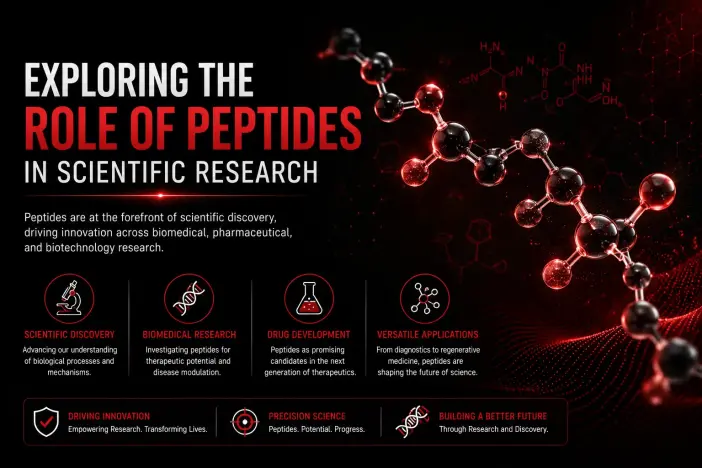
Dragon Pharma products have contributed to growing interest in peptide research, reflecting the broader expansion of scientific investigation into these biologically active molecules. The field of peptides in scientific research has expanded rapidly over the past several decades as scientists continue to discover how these small biological molecules influence communication between cells. Peptides play important roles throughout living organisms, acting as signaling molecules that help regulate processes such as metabolism, immune responses, cellular communication, and tissue organization.
Because of their ability to interact with specific biological targets, peptides have become a major focus of research in biotechnology, molecular biology, pharmaceutical development, regenerative science, and biomedical innovation.
However, it is important to understand that peptide research exists across different stages of development. While some peptide-based medicines have successfully reached clinical use, many experimental peptides remain under investigation. Preclinical findings and laboratory discoveries require further clinical evaluation before their potential applications can be confirmed.
What Are Peptides?
Peptides are short chains of amino acids connected through chemical bonds called peptide bonds. Amino acids are the fundamental building blocks of proteins. When several amino acids join in a specific sequence, they create a peptide structure.
The biological function of a peptide depends heavily on:
- The number of amino acids in the chain
- The order of amino acids
- The three-dimensional structure
- The way peptide interacts with biological targets
Even small changes in amino acid sequence can significantly influence how peptide behaves within biological systems.
Peptide Structure: Amino Acid Chains and Biological Function
A peptide is created when amino acids are linked together through peptide bonds. The basic structure involves:
- Amino acid building blocks
- Chemical bonding between amino acids
- A specific sequence that determines biological activity
The sequence of amino acids acts like a molecular blueprint, guiding how the peptide interacts with cells, receptors, and signaling pathways. This sequence-specific behavior is one reason peptides are valuable in molecular biology research.
Peptides vs Proteins: Understanding the Difference
Although peptides and proteins are closely related, they are not identical.
Naturally Occurring Peptides in the Human Body
Many peptides occur naturally within the human body and participate in essential biological processes. Examples include:
Peptide Hormones
Some hormones are peptide-based and help regulate important functions. Examples include:
- Insulin
- Growth hormone-related signaling molecules
- Glucagon-like peptides
These molecules help coordinate communication between different tissues.
Immune Signaling Peptides
The immune system uses peptide molecules to communicate and coordinate responses. Researchers study these peptides to better understand:
- Immune regulation
- Inflammatory pathways
- Cellular defense mechanisms
Neuroactive Peptides
Some peptides are involved in communication within the nervous system. They may influence:
- Neural signaling
- Stress responses
- Communication between nerve cells
Why Peptides Are Important in Scientific Research
Peptides are valuable research tools because they allow scientists to study highly specific biological interactions. Researchers investigate peptides because they can:
- Interact with specific receptors
- Influence cellular communication
- Provide information about biological pathways
- Serve as models for therapeutic development
This specificity has made peptides an important area of peptide biotechnology and pharmaceutical research.
How Peptides Work in Biological Systems
One of the most important functions of peptides is their role as signaling molecules. Cells communicate through complex networks involving:
- Hormones
- Receptors
- Enzymes
- Signaling proteins
- Genetic responses
Peptides can act as biological messengers by attaching receptors on cell surfaces. When a peptide binds to a receptor, it may trigger a series of cellular responses.
Interaction With Cell Receptors
Many peptides function by interacting with specific receptors located on cell membranes. A simplified process:
- A peptide reaches a target cell.
- The peptide binds to a compatible receptor.
- The receptor activates internal signaling pathways.
- The cell changes its activity based on the signal.
This receptor-based communication allows peptides to influence biological processes in a targeted manner.
Regulation of Cellular Responses
Through receptor interactions, peptides may influence:
- Cellular growth signals
- Metabolic activity
- Immune communication
- Tissue organization
- Protein production pathways
Scientists study these interactions to understand how biological systems regulate themselves and how peptide-based approaches may be developed.
Peptides and Gene Regulation Research
Some peptide signaling pathways can influence gene activity indirectly. When peptides interact with receptors, they may activate signaling networks that affect:
- Gene expression patterns
- Protein production
- Cellular behavior
Researchers investigate these relationships to understand how peptides communicate information between cells and genetic systems.
Molecular Targeting and Precision Research
One reason peptides are widely studied is their ability to interact with specific biological targets. Scientists can modify peptide structures to investigate:
- Receptor interactions
- Cellular pathways
- Targeted delivery approaches
This has contributed to interest in peptide-based approaches within precision medicine research.
Peptide Synthesis and Laboratory Research
Understanding Peptide Synthesis
Peptide synthesis is the laboratory process used to create specific peptide sequences. Scientists use synthetic techniques to produce peptides that match precise molecular designs. Synthetic peptide production allows researchers to study:
- Biological mechanisms
- Receptor interactions
- Cellular responses
- Potential applications
Solid-Phase Peptide Synthesis (SPPS)
One of the most common laboratory methods for producing peptides is solid-phase peptide synthesis (SPPS). The general process involves:
- Attaching the first amino acid to a solid support.
- Adding additional amino acids in a controlled sequence.
- Removing protective chemical groups.
- Releasing the completed peptide.
- Purifying and analyzing the final product.
SPPS has become a foundational technique in peptide biotechnology.
Purification and Quality Testing
After synthesis, researchers carefully analyze peptides to confirm their characteristics.
Important evaluation steps include:
- Purity testing
- Molecular analysis
- Structural confirmation
- Stability assessment
Accurate characterization is essential because peptide structure directly affects biological activity.
Structural Analysis in Peptide Research
Scientists use advanced analytical methods to study peptide properties.
These methods help confirm:
- Correct amino acid sequence
- Molecular identity
- Chemical stability
- Research consistency
High-quality peptide preparation is essential for reliable scientific studies.
Major Areas of Peptide Research
The field of peptide research covers a wide range of scientific disciplines, from pharmaceutical development to regenerative biology. Because peptides can interact with specific biological pathways, researchers continue investigating their potential roles in understanding disease mechanisms, improving drug delivery approaches, and developing new biomedical technologies.
While some peptide-based products have become established medical tools, many peptides remain experimental and require additional research to determine their potential applications.
1. Pharmaceutical and Drug Development Research
Peptides as Potential Therapeutic Molecules
One of the largest areas of peptide biotechnology is pharmaceutical research.
Scientists study peptides because they may offer several useful characteristics:
- High biological specificity
- Ability to interact with targeted receptors
- Flexible molecular design
- Potential for selective biological activity
Unlike many traditional small-molecule drugs that may interact with multiple targets, peptides can often be designed to influence specific biological pathways. This has made peptide-based medicine an important area of biomedical research.
Peptide-Based Medicines
Some peptide-based therapies have already become part of modern medicine.
Examples of approved peptide medicines include:
- Insulin-based therapies for glucose regulation
- Certain hormone-related treatments
- Peptide-based medications involved in metabolic regulation
These examples demonstrate that peptides can successfully function as therapeutic molecules when supported by extensive research and clinical evaluation. However, approved peptide medicines should be distinguished from experimental research peptides, which may still be undergoing investigation.
Targeted Drug Delivery Research
Researchers are also exploring peptides as tools for targeted delivery systems. Because certain peptides can recognize specific cellular receptors, scientists are investigating whether they can help deliver:
- Therapeutic molecules
- Imaging agents
- Research compounds
This area of study is particularly important in precision medicine research, where scientists aim to create more targeted biological approaches.
2. Regenerative Medicine and Tissue Research
Regenerative science focuses on understanding how tissues maintain structure, repair damage, and communicate at the cellular level. Peptides are being investigated because many biological repair processes depend on signaling molecules.
Research areas include:
- Cellular communication
- Tissue organization
- Extracellular matrix regulation
- Wound healing pathways
Peptides in Tissue Repair Research
Tissue repair requires coordination between many biological systems, including:
- Cells
- Growth factors
- Structural proteins
- Immune pathways
Researchers are studying peptides that may interact with repair-related signaling pathways.
Some investigations focus on how peptides influence:
- Cell migration
- Extracellular matrix activity
- Collagen-related processes
- Cellular communication
However, many regenerative peptide applications remain experimental and require additional scientific validation.
Extracellular Matrix Regulation
The extracellular matrix (ECM) provides structural support around cells. It contains important components such as:
- Collagen
- Elastin
- Proteoglycans
Researchers are exploring how certain peptides may influence ECM-related pathways because these structures are essential for tissue organization.
This research contributes to broader studies involving:
- Tissue engineering
- Biomaterials
- Regenerative medicine
3. Anti-Inflammatory and Immune Research
Inflammation is a complex biological process that helps the body respond to injury, infection, and cellular stress. However, researchers recognize that inflammation involves many interconnected pathways. Scientists study peptides because some peptides naturally participate in immune communication.
Peptides and Immune Signaling Pathways
Research is investigating how peptides may interact with:
- Cytokine signaling
- Immune cell communication
- Inflammatory pathways
Potential areas of study include:
- Understanding immune regulation
- Studying inflammatory mechanisms
- Developing future research models
Preclinical studies provide insights into these mechanisms, but clinical evidence varies depending on the specific peptide being studied.
4. Metabolism and Hormone Research
Many important biological hormones are peptide-based. Researchers study peptide hormones because they influence processes such as:
- Energy balance
- Appetite regulation
- Glucose metabolism
- Cellular communication
Metabolic peptide research has become a major area within endocrinology and biotechnology.
Peptides in Appetite and Glucose Research
Scientists continue investigating peptides involved in metabolic pathways, including those related to:
- Blood glucose regulation
- Appetite signaling
- Energy management
Some peptide-based medicines have already demonstrated clinical value in metabolic health applications. Other experimental peptides continue to be studied to better understand hormone signaling pathways.
5. Cancer and Targeted Therapy Research
Cancer research often focuses on finding ways to identify and target specific biological characteristics of tumor cells. Peptides are being investigated because some can interact with molecular targets. Researchers are exploring peptide-based strategies involving:
- Tumor recognition
- Targeted delivery systems
- Diagnostic imaging
- Molecular targeting
Peptide-Based Targeting Approaches
One area of interest is using peptides as molecular guides. Researchers investigate whether certain peptides can help:
- Identify specific cellular markers
- Deliver therapeutic compounds
- Improve targeting accuracy
This field represents an active area of biomedical research.
Popular Research Peptides and Scientific Interest
Many peptides have gained attention in scientific discussions because of their unique biological mechanisms. However, research interest does not automatically mean proven clinical effectiveness. The following examples represent areas of scientific investigation.
GHK-Cu Peptide
What Researchers Are Studying
GHK-Cu is a copper-binding peptide complex studied in areas related to:
- Cellular signaling
- Extracellular matrix research
- Collagen-related pathways
- Tissue organization
Researchers are investigating how GHK-Cu interacts with biological systems involved in repair and cellular communication.
Current Evidence Level
Evidence includes laboratory and preclinical studies. Further research is needed to understand broader biological applications.
BPC-157
What Researchers Are Studying
BPC-157 is a synthetic peptide investigated mainly in preclinical research. Studies have explored its relationship with:
- Tissue-related signaling
- Cellular responses
- Repair mechanisms
Current Evidence Level
Most available findings come from laboratory and animal research. Human clinical evidence remains limited.
Conclusion
Interest in Dragon Pharma Buy searches reflects the growing attention surrounding peptide research and the broader expansion of scientific investigation into biologically active molecules. The field of peptide science has developed rapidly over the past several decades as researchers continue to explore how these small biological molecules influence communication between cells. Peptides play important roles throughout living organisms, acting as signaling molecules that help regulate processes such as metabolism, immune responses, cellular communication, and tissue organization.
Scientific investigations have shown that peptides can influence a wide range of biological pathways, including hormone signaling, immune communication, metabolic regulation, tissue organization, and molecular interactions. These discoveries have contributed to advances in peptide-based medicine, pharmaceutical development, regenerative research, and targeted therapeutic approaches.
One of the key strengths of peptides is their ability to interact with specific biological targets. This specificity has encouraged researchers to explore peptides as potential components of precision medicine, targeted delivery systems, and next-generation biotechnology solutions.
However, peptide science is a continually developing field. While some peptide-based medicines have already demonstrated clinical value, many experimental peptides remain in early research stages. Laboratory discoveries and preclinical findings provide important insights, but further scientific investigation is required to determine broader applications.
As technologies such as artificial intelligence, computational biology, and advanced delivery systems continue to evolve, the future of peptide science may bring new opportunities for understanding biology and developing innovative biomedical solutions.
For now, Dragon Pharma Peptides are part of the broader interest surrounding peptide science and research. Peptides remain a powerful area of scientific exploration, offering researchers new ways to study cellular communication, biological regulation, and the complex mechanisms that influence human health.