
July 7, 2026 · 8 min read
Understanding CJC-1295 DAC vs No DAC
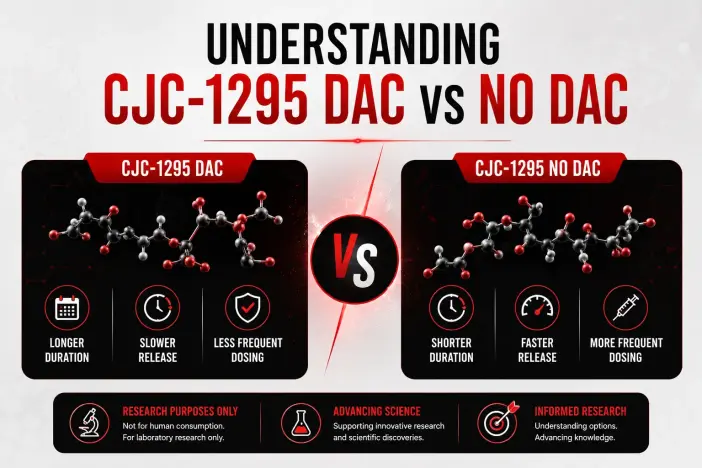
Interest in peptides that interact with natural growth hormone signaling has grown across peptide science, endocrinology, metabolism research, and regenerative medicine research. Among the compounds frequently discussed in this area are CJC-1295 DAC and CJC-1295 No DAC.
Although these two peptides are closely related, they are not identical in how long they are designed to remain active in circulation. Their central difference is the presence or absence of a Drug Affinity Complex, commonly called DAC. This structural distinction can influence peptide stability, albumin binding, and the duration of growth hormone-related signaling observed in research settings.
Understanding CJC-1295 Peptide vs No DAC is important for researchers studying growth hormone release patterns, tissue maintenance, body composition, sleep-related hormone signaling, cellular repair processes, and peptide pharmacokinetics.
What Is CJC-1295?
CJC-1295 is a synthetic peptide related to growth hormone-releasing hormone, also known as GHRH. GHRH is a naturally occurring signaling peptide produced in the hypothalamus that communicates with the pituitary gland and helps regulate the release of growth hormone.
Rather than functioning as growth hormone itself, CJC-1295-related peptides are studied for their potential ability to influence the body's endogenous growth hormone signaling pathways. In simple terms, researchers investigate whether these peptides may encourage the pituitary gland to release growth hormone through normal biological communication systems.
What Is CJC-1295 No DAC?
CJC-1295 No DAC generally refers to the shorter-acting form of Modified GRF (1-29). The term "No DAC" means that the peptide does not contain the additional Drug Affinity Complex attached to the molecule.
Because it lacks the DAC modification, CJC-1295 No DAC is generally discussed as having a shorter duration in circulation than CJC-1295 DAC. This shorter activity window has made it relevant to research examining more temporary GHRH-related signaling patterns.
Researchers may view CJC-1295 No DAC as closer to the body's natural pulsatile growth hormone release pattern. Growth hormone is not normally released at a constant level throughout the day. Instead, secretion occurs in pulses that can vary based on circadian rhythms, sleep, metabolic state, age, and other biological factors.
What Is CJC-1295 DAC?
CJC-1295 DAC is a modified form of CJC-1295 that includes an added Drug Affinity Complex. DAC stands for Drug Affinity Complex, a structural addition designed to extend the peptide's time in circulation.
The DAC modification is associated with albumin binding in the bloodstream. Albumin is a naturally occurring protein found in blood plasma. It performs several transport-related functions and can interact with certain compounds in ways that may affect how long they remain in circulation.
In CJC-1295 DAC research, the added complex is designed to support binding with albumin, which may slow peptide breakdown and prolong its biological presence. This is why CJC-1295 DAC is commonly described as a longer-acting GHRH-related peptide compared with CJC-1295 No DAC.
Half-Life and Duration of Action
The most widely discussed difference between CJC-1295 DAC and CJC-1295 No DAC is their half-life. Half-life refers to the approximate time required for the amount of a substance in circulation to decrease by half. In peptide research, half-life matters because it can influence how long a compound remains available to interact with biological signaling pathways.
CJC-1295 No DAC is generally associated with a shorter half-life. Its activity profile is often compared with the naturally brief signaling behavior of endogenous GHRH. CJC-1295 DAC is designed for prolonged circulation. The added DAC component may extend the peptide's half-life by supporting albumin binding, which can reduce the rate at which the peptide is cleared or broken down.
This difference in duration is important because researchers may use shorter-acting and longer-acting peptide forms to study different biological questions. One model may be more useful for examining temporary hormone signaling, while another may be more useful for observing extended changes in growth hormone-related pathways.
Growth Hormone Release Pattern
Both CJC-1295 DAC and CJC-1295 No DAC are researched for their potential influence on endogenous growth hormone release.
Growth hormone is produced by the pituitary gland and released in pulses rather than as a constant stream. These pulses are influenced by the body's circadian rhythm, sleep patterns, metabolic activity, stress response, and other hormonal signals.
GHRH is one of the natural signals involved in stimulating pituitary growth hormone release. Since CJC-1295-related peptides are designed around GHRH activity, researchers study how they may interact with this signaling pathway. CJC-1295 No DAC is often discussed in relation to shorter, more temporary signaling windows. CJC-1295 DAC is studied for its potential to create a more prolonged growth hormone-related signaling environment.
Research continues to examine how peptide structure, duration, and albumin binding may influence the timing and persistence of growth hormone release patterns. These findings remain an evolving area of scientific inquiry.
Research Design Considerations
The different duration profiles of CJC-1295 DAC and No DAC can influence how researchers design studies. Shorter-acting research models may be useful when scientists want to observe temporary signaling activity, pulse-related hormone responses, or short-term interactions with the GHRH pathway.
Longer-acting research models may be useful for studying extended peptide circulation, prolonged hormone-related signaling, or longer observation periods involving growth hormone and insulin-like growth factor pathways.
Researchers must carefully interpret findings from each peptide form because CJC-1295 DAC and CJC-1295 No DAC may not produce identical timing or duration profiles. Comparing the two without considering their pharmacokinetic differences can lead to misleading conclusions.
Growth Hormone Signaling Research
One of the primary research areas involving CJC-1295 DAC and CJC-1295 No DAC is endogenous growth hormone signaling. Growth hormone is involved in normal biological processes such as cellular growth, protein metabolism, tissue maintenance, energy use, and repair-related signaling. Scientists study GHRH-related peptides to better understand how pituitary hormone release can be influenced through natural signaling pathways.
CJC-1295 research does not involve replacing growth hormone directly. Instead, it focuses on how modified GHRH-related peptides may affect the biological communication process that encourages the pituitary gland to release growth hormone. More research is needed to understand how these signaling changes may differ across populations, biological conditions, and research models.
Body Composition Research
Growth hormone signaling is also an area of interest in body composition research. Scientists study the relationship between growth hormone pathways and lean tissue maintenance, fat metabolism, energy use, muscle cell development, and metabolic activity. These processes are complex and influenced by many factors, including nutrition, sleep, activity level, age, genetics, and overall hormonal health.
CJC-1295 DAC and No DAC are sometimes discussed in relation to this research because of their potential influence on endogenous growth hormone release. However, research interest in body composition should not be interpreted as evidence that either peptide causes fat loss, muscle gain, or specific physical changes. The value of this research lies in understanding how growth hormone-related signaling may contribute to broader metabolic and tissue-maintenance processes.
Tissue Recovery and Regeneration Research
Another area of scientific interest involves tissue recovery and regeneration biology. Growth hormone-related pathways are studied for their possible relationship with cellular repair processes, tissue maintenance, connective tissue research, recovery biology, and skin cell support. These biological systems are important because the body constantly repairs and remodels tissues throughout life.
Researchers are interested in whether GHRH-related peptides may provide useful models for studying repair-related signaling. This includes examining how growth hormone pathways may interact with protein synthesis, cellular turnover, tissue structure, and recovery mechanisms. These research areas remain investigational. Findings from laboratory studies, animal studies, or limited human research should not be treated as established therapeutic outcomes.
Sleep and Circadian Rhythm Research
Growth hormone secretion is closely connected to sleep and circadian rhythms. The circadian rhythm is the body's internal timing system that helps regulate sleep, hormone release, metabolism, temperature, and other daily biological processes. Growth hormone pulses are often associated with sleep-related biological activity, particularly during deeper sleep stages.
Researchers studying CJC-1295 DAC and No DAC are interested in how GHRH-related peptides may interact with these natural hormone rhythms. The shorter activity profile of No DAC and the longer duration of DAC may offer different models for examining the timing of growth hormone-related signaling. The relationship between growth hormone, sleep, and circadian biology is complex, and ongoing research is needed to clarify how modified GHRH peptides may fit into this broader biological picture.
Skin and Collagen Research
Collagen is a structural protein that contributes to tissue organization, skin structure, and connective tissue integrity. Researchers examine how hormonal signaling may influence collagen production, skin cell turnover, tissue maintenance, and broader cellular repair processes.
Because growth hormone is involved in normal tissue maintenance, CJC-1295-related peptides may be of interest in research exploring skin cell biology and connective tissue signaling. However, this should not be interpreted as a cosmetic, anti-aging, or skin-enhancing promise.
The scientific relevance lies in understanding the biological pathways involved in tissue structure and cellular maintenance.
Conclusion
CJC-1295 DAC and CJC-1295 No DAC are closely related peptides for sale, both of which are GHRH-based peptides studied for their potential influence on natural growth hormone signaling. The primary difference is the Drug Affinity Complex found in CJC-1295 DAC. This DAC component is designed to support albumin binding and extend the peptide's time in circulation.
CJC-1295 No DAC is generally associated with shorter duration and is often discussed in relation to more temporary, pulsatile GHRH-related signaling. CJC-1295 DAC is associated with longer-lasting activity and extended observation models in peptide research.
As the field grows for researchers looking to buy USA peptide options, responsible interpretation of science remains essential. Current research provides useful insights into GHRH-related signaling, but more clinical research is needed to understand the full biological significance of CJC-1295 DAC and CJC-1295 No DAC.