 -40% OFF
Dragon Pharma, Europe
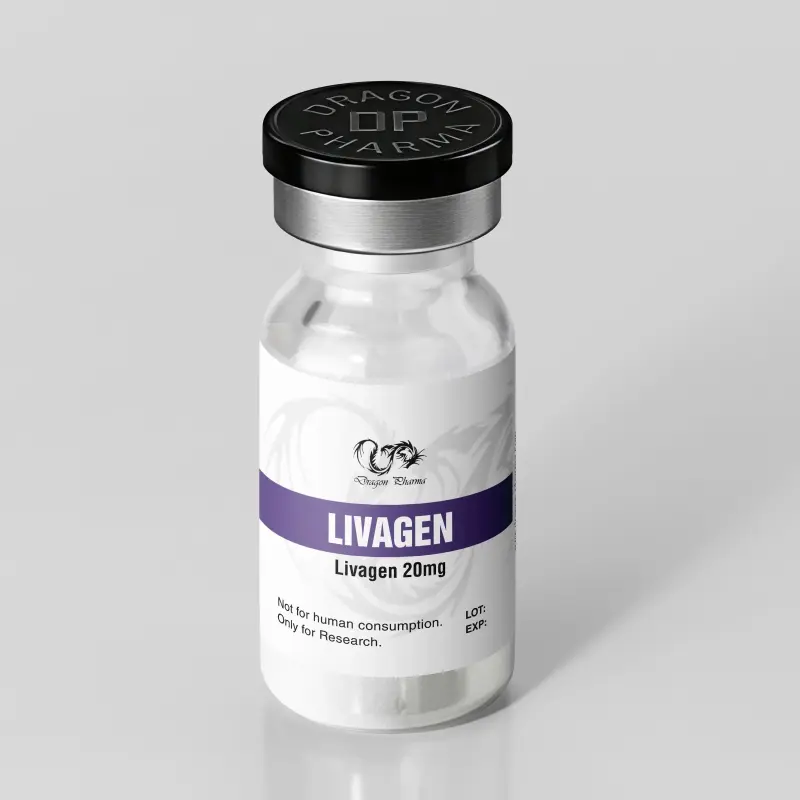
Livagen
Injection · 20mg · vial
$69.00
$115.00
You will save $46.00
Compound ID
Livagen
Strength
20 mg/vial
Form
Lyophilized Powder
Packaging
2 mL Vial
Classification
Peptide Fragment
Active Substance
Livagen
Active Half-Life
~2–4 Hours
Properties
Shipping
Not available in this combination
Product overview
Dragon Pharma Ovagen Peptide
Dragon Pharma Ovagen is a research-grade synthetic tripeptide bioregulator supplied as a lyophilized powder for qualified laboratory investigation. Composed of the amino acid sequence H-Glu-Asp-Leu-OH — also abbreviated in scientific literature as EDL — Ovagen belongs to the Khavinson cytogen class of ultrashort regulatory peptides developed at the St. Petersburg Institute of Bioregulation and Gerontology.
The Glu-Asp-Leu sequence has attracted scientific interest for its tissue-specific activity in hepatic and gastrointestinal biology, its capacity to interact with chromatin structure and DNA regulatory regions, and its well-characterized role as a competitive inhibitor of HIV-1 protease in published biochemical studies. Its compact three-residue structure provides high membrane permeability and nuclear accessibility, distinguishing it from larger polypeptide bioregulators while retaining targeted gene-regulatory influence.
Every batch of Dragon Pharma Ovagen is manufactured under strict quality control procedures to ensure purity, molecular integrity, and batch-to-batch consistency. The peptide is supplied as a lyophilized powder without unnecessary fillers or excipients, preserving stability during storage and providing dependable performance across in vitro research applications.
Peptide Specifications
| Property | Value |
|---|---|
| Product | Dragon Pharma Ovagen |
| Peptide Type | Synthetic Tripeptide Bioregulator |
| Peptide Sequence | H-Glu-Asp-Leu-OH |
| Common Abbreviation | EDL |
| Molecular Formula | C15H25N3O8 |
| Molecular Weight | 375.37 g/mol |
| PubChem CID | 444128 |
| Peptide Family | Khavinson Cytogen Series |
| Tissue Target | Liver (hepatic) and gastrointestinal epithelium |
| Form | Lyophilized Peptide Powder |
| Purity | ≥99% (HPLC and LC-MS verified) |
| COA | Independent third-party, batch-specific |
| Storage (lyophilized) | -20°C, up to 24 months |
| Storage (reconstituted) | 2–8°C, use within 28 days |
| Research Classification | Research Use Only |
Molecular Structure and Biological Activity
Ovagen is a low-molecular-weight tripeptide composed of three amino acid residues: glutamic acid (Glu), aspartic acid (Asp), and leucine (Leu). The structural arrangement of this sequence is biologically significant. The adjacent acidic residues — glutamic acid and aspartic acid — contribute a negatively charged, hydrophilic character that enables aqueous solubility and electrostatic interaction with DNA and chromatin-associated proteins. The terminal leucine residue introduces a hydrophobic component that facilitates insertion into the minor groove of DNA, a property that distinguishes Glu-Asp-Leu from neutral or positively charged short peptides.
This structural combination gives Ovagen two key physical properties relevant to its research utility: high membrane permeability allowing passive diffusion across both cellular and nuclear membranes, and sequence-specific DNA binding capacity enabling direct interaction with regulatory regions in target tissue genes. Within the Khavinson bioregulatory model, these properties are proposed to allow the peptide to function as an endogenous molecular messenger, modulating chromatin accessibility and gene expression in a tissue-specific manner through interaction with promoter regions of hepatic and gastrointestinal genes.
The peptide is selectively taken up by hepatocytes and gastrointestinal epithelial cells through proton-coupled oligopeptide transporters (PepT1/SLC15A1 and PepT2/SLC15A2) — transport proteins expressed at high density in these specific tissues — providing a biochemical basis for the tissue specificity observed in laboratory models.
Mechanism of Action
Laboratory research indicates that Ovagen participates in molecular pathways associated with chromatin remodeling, gene expression regulation, and tissue-specific peptide signaling in hepatic and gastrointestinal cell models.
Documented and investigated mechanisms include:
- Chromatin decondensation and activation of previously silenced gene regions in hepatocyte models
- Interaction with DNA regulatory sequences in promoter regions of liver and GI tissue-expressed genes
- Modulation of hepatocyte proliferation-associated signaling and cellular resilience under oxidative stress conditions
- Normalization of hepatic detoxification enzyme expression, including cytochrome P450 family and glutathione S-transferases, in preclinical models
- Restoration of gastrointestinal mucosal barrier integrity markers in aging and chemical stress models
- Competitive inhibition of HIV-1 protease in vitro, with a documented Ki value of approximately 50 μM (Louis et al., 1998)
- Prolonged cell survival and increased proliferative activity in cultured hepatic cell models
- Modulation of inflammatory cytokine expression in intestinal tissue research models
- Gene expression regulation through peptide-DNA interaction at the epigenetic level
The competitive inhibition of HIV-1 protease is among the most rigorously characterized activities of the Glu-Asp-Leu sequence in published biochemistry. Kinetic analysis demonstrates that EDL functions as a competitive inhibitor derived from the viral transframe region (TFR), providing a well-defined molecular binding model for structure-activity relationship studies involving this tripeptide.
Areas of Scientific Research
Liver and Hepatic Research
Ovagen has primarily been investigated as a peptide bioregulator for laboratory studies involving liver biology and hepatic physiology. Its tissue-selective uptake by hepatocytes and documented activity in hepatic cell models make it a relevant research tool for studying the molecular biology of liver function, particularly in aging-related contexts.
Experimental research has examined its potential relationship with:
- Hepatocyte gene expression and chromatin accessibility
- Liver detoxification pathway regulation in preclinical models
- Hepatic protein synthesis and albumin production in aged cell models
- Liver fibrosis signaling and hepatocellular regeneration markers
- Oxidative stress response and antioxidant enzyme expression in hepatic tissue
- Age-related changes in hepatic metabolic function
- Hepatocyte proliferation and cell survival signaling
- Liver-gut axis coordination in gastrointestinal-hepatic research models
These investigations continue to expand laboratory understanding of peptide-mediated regulation within hepatic tissue, with particular relevance to geroscience research examining age-dependent changes in liver function.
Gastrointestinal Research
Ovagen's tissue specificity extends to the gastrointestinal epithelium, where PepT1/SLC15A1 transporter expression enables selective uptake and subsequent nuclear interaction in GI mucosal cells. Research has examined Ovagen within models investigating gastrointestinal physiology, mucosal barrier biology, and digestive tract homeostasis.
Published and ongoing laboratory studies have examined:
- Gastrointestinal mucosal barrier integrity and epithelial tight junction expression
- GI tissue protection in chemical stress models, including antibiotic and oxidative insult conditions
- Digestive enzyme regulation and gastrointestinal secretory function
- Intestinal epithelial cell differentiation and tissue remodeling
- Gastric mucosa protection signaling pathways
- Inflammatory cytokine modulation in intestinal tissue research models
- Coordinated liver-gut axis biology and hepato-gastrointestinal signaling
Protein Interaction and Enzyme Inhibition Research
One of the most precisely characterized laboratory applications of the Glu-Asp-Leu sequence involves protein interaction and enzyme inhibition studies. Louis et al. (1998) demonstrated that the EDL tripeptide functions as a competitive inhibitor of mature HIV-1 protease in vitro, derived from the transframe region (TFR) of Gag-Pol.
Kinetic analysis established a Ki value of approximately 50 μM for EDL against HIV-1 protease — a measurable inhibitory potency notable for a three-residue peptide structure. The closely related sequence Glu-Asp-Phe demonstrated even greater potency (Ki ≈ 20 μM), providing a structure-activity comparison framework for peptide-enzyme recognition research.
These studies have provided valuable insights into:
- Peptide-enzyme molecular recognition and binding specificity
- Competitive inhibition kinetics at defined Ki values
- Structure-activity relationships in short hydrophilic peptide sequences
- Transframe region peptide biology and viral protease regulation
- Peptide-based inhibitor design for protease research applications
Cellular Regulation and Aging Research
Peptide bioregulators from the Khavinson series have become increasingly important tools for studying fundamental cellular biology, particularly in the context of cellular aging, epigenetic regulation, and tissue homeostasis maintenance.
Current research involving Ovagen includes investigation into:
- Epigenetic chromatin modification and gene reactivation in aging cell models
- Cellular proliferation and differentiation signaling in hepatic and renal cell systems
- Age-dependent changes in peptide bioregulator activity and tissue responsiveness
- Comparative bioregulator research within the Khavinson cytogen framework
- Intracellular gene expression normalization in senescent cell models
- Molecular interactions between short regulatory peptides and chromatin-associated structures
Ovagen complements Livagen (Lys-Glu-Asp-Ala) within the liver-targeted Khavinson bioregulator category. The two peptides carry different amino acid sequences and are proposed to exhibit distinct gene regulatory specificity within hepatic tissue, making comparative research protocols using both compounds a common approach in Khavinson bioregulator studies.
Molecular Biology and Structure-Activity Research
The compact, well-defined structure of Ovagen makes it a valuable model compound for investigating peptide chemistry and molecular biology at the sequence level.
Current laboratory investigations include:
- Peptide-DNA interaction studies using fluorescence spectroscopy and biophysical methods
- Transporter-mediated cellular uptake mechanisms via PepT1 and PepT2
- Nuclear membrane penetration and chromatin accessibility studies
- Peptide stability and degradation kinetics in biological matrices
- Structure-activity relationship comparisons within the EDL/EDX tripeptide family
- Molecular recognition and binding specificity in enzyme inhibition models
Ovagen vs Livagen: Understanding the Difference
Ovagen (EDL / Glu-Asp-Leu) and Livagen (KEDA / Lys-Glu-Asp-Ala) are both Khavinson-series liver-targeted bioregulators, but they are structurally distinct compounds with different amino acid sequences and proposed gene regulatory specificity profiles.
| Feature | Ovagen (EDL) | Livagen (KEDA) |
|---|---|---|
| Peptide length | Tripeptide (3 residues) | Tetrapeptide (4 residues) |
| Sequence | H-Glu-Asp-Leu-OH | H-Lys-Glu-Asp-Ala-OH |
| Molecular weight | 375.37 g/mol | 461.5 g/mol |
| Primary tissue target | Liver and GI epithelium | Liver and immune cells |
| Research relationship | Complementary — distinct gene regulatory specificity | Complementary — distinct chromatin interaction profile |
| Common use in research | Often studied in parallel with Livagen in hepatic models | Often studied in parallel with Ovagen in hepatic models |
Lyophilized Peptide Technology
Dragon Pharma Ovagen is manufactured as a lyophilized peptide using advanced freeze-drying technology to maximize molecular stability and preserve peptide integrity throughout storage and laboratory handling. Lyophilization removes water from the peptide under vacuum conditions, producing a stable powder that is significantly less susceptible to hydrolytic degradation than liquid formulations.
Benefits of lyophilization for Ovagen include:
- Extended shelf life stability at -20°C — up to 24 months in lyophilized form
- Elimination of cold-chain dependency during standard domestic shipping conditions
- Preservation of peptide purity and molecular integrity between manufacturing and reconstitution
- No unnecessary fillers, excipients, or preservatives that could interfere with downstream assay conditions
- Reliable reconstitution characteristics with bacteriostatic or sterile water
- Reduced risk of aggregation, oxidation, or degradation relative to pre-reconstituted solutions
Storage and Handling
Lyophilized powder (unreconstituted): Store at -20°C in a dry, light-protected environment. Stable for up to 24 months under these conditions. Allow vial to reach room temperature before opening to prevent condensation from entering the vial.
Reconstituted solution: Store at 2–8°C (refrigerated). Use within 28 days of reconstitution. Avoid repeated freeze-thaw cycles, which degrade peptide integrity and reduce assay reproducibility.
Reconstitution guidance: Bacteriostatic water or sterile water is the standard diluent. Introduce diluent slowly by directing the stream against the inner vial wall rather than injecting directly into the lyophilized powder cake, to prevent mechanical disruption of the peptide. Swirl gently until fully dissolved. Do not shake or vortex. All handling should take place in a sterile environment with appropriate personal protective equipment.
For research use only. Not for human consumption, veterinary use, or therapeutic application.
Quality Assurance
Dragon Pharma follows rigorous manufacturing and quality assurance standards to deliver dependable research compounds across its full peptide catalog. Every production batch of Ovagen undergoes comprehensive laboratory evaluation before release.
Batch quality documentation includes:
- HPLC (High-Performance Liquid Chromatography) — purity confirmed at ≥99%
- LC-MS (Liquid Chromatography-Mass Spectrometry) — molecular identity and mass verification confirming the correct Glu-Asp-Leu sequence and 375.37 g/mol molecular weight
- Sterility and endotoxin screening — per batch, applicable to vial specification
- Residual solvent and chemical contaminant screening
- Batch consistency analysis — lot-to-lot uniformity across production runs
All COA documentation is sourced from independent certified third-party laboratories. Batch numbers on vial labels correspond directly to COA records, providing full traceability from manufacturing to delivery. Certificates of Analysis are made available per batch for researcher verification before experimental use.
Why Choose Dragon Pharma Ovagen?
- ✔ Research-grade manufacturing — produced to pharmaceutical-quality specifications with independently verified purity
- ✔ ≥99% purity by HPLC and LC-MS — exceeds the ≥98% standard, reducing experimental confound risk in sensitive peptide assays
- ✔ Independent third-party COA per batch — traceable lot-specific documentation, not generic in-house certification
- ✔ Lyophilized powder — no fillers or excipients — clean formulation for precise laboratory applications
- ✔ EDL abbreviation clearly documented — full sequence and CAS alignment with published Ovagen literature
- ✔ Complementary to Livagen — Dragon Pharma supplies both liver-targeted Khavinson bioregulators for comparative hepatic research protocols
- ✔ Well-characterized biochemistry — published peer-reviewed data on HIV-1 protease inhibition provides a defined molecular reference point for structure-activity research
- ✔ Trusted Dragon Pharma manufacturing standards — the same quality infrastructure applied across the full Dragon Pharma research peptide catalog
Frequently Asked Questions About Dragon Pharma Ovagen
What is Dragon Pharma Ovagen?
Dragon Pharma Ovagen is a research-grade lyophilized synthetic tripeptide bioregulator with the amino acid sequence Glu-Asp-Leu (EDL), supplied in 20mg vials with independent third-party COA documentation. It belongs to the Khavinson cytogen peptide series and is developed for in vitro research into hepatic biology, gastrointestinal epithelial regulation, chromatin remodeling, and enzyme inhibition studies. For research use only.
What does EDL stand for?
EDL is the single-letter amino acid abbreviation for the Ovagen tripeptide sequence: E (Glutamic acid), D (Aspartic acid), L (Leucine). The abbreviation is used interchangeably with Ovagen in scientific literature and is the notation used in the primary HIV-1 protease inhibition study (Louis et al., 1998).
How does Ovagen differ from Livagen?
Ovagen (Glu-Asp-Leu / EDL) is a tripeptide; Livagen (Lys-Glu-Asp-Ala / KEDA) is a tetrapeptide. Both are Khavinson-series bioregulators with liver tissue targeting, but they carry different amino acid sequences and are proposed to exhibit distinct gene regulatory specificity in hepatic tissue. Research protocols frequently examine both compounds in parallel as complementary rather than equivalent tools.
What is the molecular weight of Ovagen?
Ovagen (Glu-Asp-Leu) has a molecular weight of 375.37 g/mol and a molecular formula of C15H25N3O8. Its PubChem CID is 444128.
What purity standard does Dragon Pharma Ovagen meet?
Dragon Pharma Ovagen is verified at ≥99% purity by HPLC. Molecular identity is confirmed by LC-MS, verifying the correct Glu-Asp-Leu sequence and molecular weight of 375.37 g/mol. COA documentation is issued by independent third-party certified laboratories on a batch-specific basis.
How should Dragon Pharma Ovagen be stored?
Unreconstituted lyophilized powder should be stored at -20°C, where it remains stable for up to 24 months. After reconstitution with bacteriostatic or sterile water, store at 2–8°C and use within 28 days. Avoid repeated freeze-thaw cycles and protect from light and moisture throughout storage.
What is the HIV-1 protease inhibition research associated with Ovagen?
Louis et al. (1998) published kinetic data demonstrating that the Glu-Asp-Leu (EDL) tripeptide competitively inhibits mature HIV-1 protease in vitro, derived from the transframe region (TFR) of Gag-Pol, with a Ki value of approximately 50 μM. This represents one of the most precisely characterized biochemical activities documented for this sequence and provides a defined molecular reference for enzyme inhibition and structure-activity research.
Is Dragon Pharma Ovagen the same as the ovine FSH product?
No. Dragon Pharma Ovagen is the tripeptide bioregulator Glu-Asp-Leu (EDL), developed by Professor Khavinson for liver and gastrointestinal research. A separately named commercial product contains ovine (sheep) follicle-stimulating hormone (FSH) and serves an entirely different biological function. Researchers should verify the peptide sequence and PubChem CID 444128 before ordering.
Can Ovagen be used alongside Livagen in research protocols?
Yes. Dragon Pharma supplies both Ovagen (EDL) and Livagen (KEDA) from its Khavinson cytogen peptide catalog. Comparative research protocols using both liver-targeted bioregulators in parallel are a common approach in geroscience and hepatic biology research, allowing investigation of distinct regulatory specificity within the same tissue system from a consistent quality-controlled source.
Scientific References
The information presented on this page is based on published peer-reviewed scientific literature investigating the Ovagen peptide and the Glu-Asp-Leu (EDL) tripeptide sequence in laboratory and preclinical research settings. Studies have examined peptide bioregulation, hepatic biology, gastrointestinal physiology, enzyme inhibition, chromatin interaction, and molecular recognition.
- Louis JM, Dyda F, Nashed NT, Kimmel AR, Davies DR. Hydrophilic Peptides Derived from the Transframe Region of Gag-Pol Inhibit the HIV-1 Protease. Biochemistry. 1998;37(7):2105–2110. DOI: https://doi.org/10.1021/bi972059x
- Khavinson VK. Peptides and Ageing. Neuro Endocrinology Letters. 2002;23(Suppl 3):11–144.
- Fedoreyeva LI, Kireev II, Khavinson VK, Vanyushin BF. Penetration of short fluorescence-labeled peptides into the nucleus in HeLa cells and in vitro specific interaction of the peptides with deoxyribooligonucleotides and DNA. Biochemistry (Moscow). 2011;76(11):1210–1219.
Dragon Pharma supplies Ovagen exclusively for laboratory research purposes.