 -40% OFF
Dragon Pharma, Europe
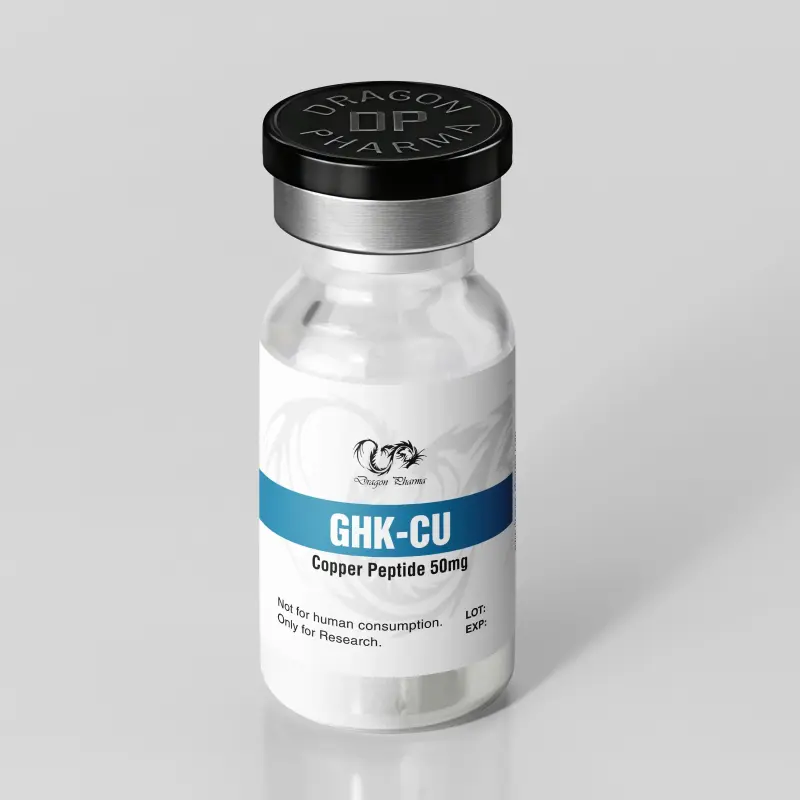
GHK-CU 50
Injection · 50mg · vial
$24.00
$40.00
You will save $16.00
Compound ID
GHK-CU
Strength
50 mg/vial
Form
Lyophilized Powder
Packaging
2 mL Vial
Classification
Copper Peptide Complex
Active Substance
GHK-CU (Gly-His-Lys Copper Peptide)
Active Half-Life
Approximately 2–3 Hours
Properties
Shipping
Not available in this combination
Product overview
Pharmaceutical-Grade GHK-Cu for Research Applications
Dragon Pharma GHK-Cu is a premium-quality copper-binding tripeptide manufactured to rigorous laboratory standards for scientific and research purposes. Composed of the naturally occurring amino acid sequence Glycine-Histidine-Lysine (GHK) complexed with a copper ion (Cu²⁺), GHK-Cu is one of the most extensively studied bioactive peptides in regenerative medicine, tissue remodeling, and skin biology.
Originally identified in human plasma by Dr. Loren Pickart, GHK-Cu occurs naturally throughout the body, although its concentration gradually declines with age. Scientific research has demonstrated its involvement in numerous biological processes, including collagen synthesis, elastin production, extracellular matrix remodeling, antioxidant defense, angiogenesis, and cellular repair. These properties have made GHK-Cu a prominent subject of investigation in skin regeneration, wound healing, hair follicle biology, pulmonary research, neurological health, and gene expression studies.
Every batch of Dragon Pharma GHK-Cu is produced under strict quality control procedures to ensure exceptional purity, consistency, and molecular integrity. The peptide is supplied as a lyophilized (freeze-dried) powder without unnecessary fillers, helping preserve stability during storage while providing reliable performance for laboratory research.
Peptide Specifications
| Property | Value |
|---|---|
| Product | Dragon Pharma GHK-Cu |
| Peptide Type | Copper-Binding Tripeptide |
| Peptide Sequence | Gly-His-Lys |
| Molecular Formula | C14H24N6O4 |
| Molecular Weight | 340.38 g/mol |
| CAS Number | 49557-75-7 |
| PubChem CID | 73587 |
| Synonyms | Glycyl-L-Histidyl-L-Lysine, Prezatide, Gly-His-Lys |
| Form | Lyophilized Peptide Powder |
| Purity | Laboratory Tested |
| Research Classification | Research Use Only |
Molecular Structure and Biological Activity
GHK-Cu consists of the naturally occurring tripeptide Glycine-Histidine-Lysine complexed with a copper ion, forming a highly bioactive peptide complex involved in numerous physiological processes. Copper serves as an essential trace element required for enzymatic activity, connective tissue maintenance, antioxidant protection, and normal cellular metabolism.
Research indicates that GHK-Cu functions as a signaling peptide capable of influencing multiple biological pathways associated with tissue remodeling, extracellular matrix maintenance, and cellular communication. Experimental investigations suggest that it supports collagen formation, elastin organization, fibroblast activity, angiogenesis, and antioxidant defenses while helping regulate inflammatory responses during tissue repair.
These characteristics have positioned GHK-Cu among the most extensively researched regenerative peptides in modern peptide science.
Mechanism of Action
Rather than acting through a single biological target, GHK-Cu appears to influence numerous molecular signaling pathways involved in tissue repair, cellular regeneration, and oxidative balance.
Current experimental research has investigated its interaction with:
- Collagen synthesis pathways
- Elastin production
- Fibroblast proliferation
- Extracellular matrix remodeling
- Vascular Endothelial Growth Factor (VEGF)
- Fibroblast Growth Factor-2 (FGF-2)
- Matrix Metalloproteinases (MMPs)
- Tissue Inhibitors of Metalloproteinases (TIMPs)
- Nuclear Factor Erythroid 2-Related Factor 2 (Nrf2)
- Nuclear Factor-kappa B (NF-κB)
- Transforming Growth Factor Beta (TGF-β1)
- Smad2/3 signaling
- Reactive Oxygen Species (ROS) regulation
- p38 MAPK signaling pathways
These interconnected pathways are associated with connective tissue remodeling, antioxidant protection, immune regulation, angiogenesis, cellular migration, and normal wound repair.
Areas of Scientific Research
Skin Regeneration and Tissue Remodeling
GHK-Cu has become one of the most widely investigated peptides in dermatological and regenerative research. Numerous experimental studies have explored its role in improving connective tissue organization, collagen deposition, elastin synthesis, and dermal remodeling.
Researchers continue to investigate GHK-Cu in laboratory models involving skin elasticity, dermal density, photodamage, fine lines, wrinkle formation, hyperpigmentation, and age-related structural changes. Its ability to influence fibroblast activity and extracellular matrix remodeling has made it a significant area of interest within cosmetic science and regenerative medicine
Wound Healing Research
Experimental studies have demonstrated that GHK-Cu promotes several biological processes involved in tissue repair, including angiogenesis, cell migration, collagen synthesis, connective tissue accumulation, and growth factor production.
Research has examined its potential involvement in:
- Surgical wound models
- Incisional wound repair
- Burn and scald injuries
- Connective tissue regeneration
- Angiogenesis
- Fibroblast activation
- Extracellular matrix remodeling
These findings continue to support ongoing research into tissue regeneration and wound biology.
Hair Follicle Research
GHK-Cu has attracted considerable interest in experimental hair biology due to its observed effects on cellular signaling involved in follicle maintenance and tissue remodeling.
Current research continues to investigate its potential relationship with:
- Hair follicle regeneration
- Dermal papilla cell activity
- Follicular vascularization
- Connective tissue remodeling
- Scalp biology
- Growth factor expression
These experimental findings have contributed to its widespread use in cosmetic and hair-related research formulations.
Pulmonary Research
Recent laboratory investigations have expanded into pulmonary biology, where GHK-Cu has demonstrated promising antioxidant and anti-inflammatory properties in experimental models.
Published studies have explored its role in:
- Pulmonary fibrosis
- Idiopathic pulmonary fibrosis (IPF)
- Chronic obstructive pulmonary disease (COPD)
- Cigarette smoke-induced emphysema
- Acute lung injury (ALI)
- Oxidative stress regulation
- Inflammatory cytokine modulation
Researchers continue evaluating its influence on Nrf2 activation, NF-κB inhibition, TGF-β1 signaling, epithelial-mesenchymal transition (EMT), collagen deposition, and matrix metalloproteinase regulation.
Neurodegenerative Research
Growing scientific interest has focused on GHK-Cu's potential influence on nervous system biology and age-related neurological changes.
Experimental studies have investigated laboratory models involving:
- Protein aggregation
- Copper and zinc homeostasis
- Neuroprotection
- Alzheimer's disease
- Amyloid plaque formation
- Cognitive decline
- Neuronal survival
- Central nervous system function
Research suggests that GHK-Cu may influence gene expression patterns associated with healthy neuronal function and oxidative balance, making it an important peptide for ongoing neuroscience research.
Antibacterial Research
Recent investigations have examined GHK-Cu nanoparticles as novel biomaterials with antibacterial properties.
Experimental models have demonstrated activity against bacterial species including:
- Escherichia coli (E. coli)
- Staphylococcus aureus (S. aureus)
Researchers continue evaluating self-assembled GHK-Cu nanoparticles for their potential role in tissue engineering, wound care materials, infection control, and biomedical applications.
Gene Expression Research
One of the defining characteristics of GHK-Cu research is its ability to influence gene expression across numerous biological pathways.
Experimental investigations have reported modulation of genes associated with:
- Tissue remodeling
- Cellular repair
- Inflammatory regulation
- Antioxidant defense
- Connective tissue maintenance
- Collagen metabolism
- Skin regeneration
- Pulmonary remodeling
- Nervous system function
These findings continue to position GHK-Cu as a unique signaling peptide within regenerative medicine research.
Experimental Oncology Research
Several laboratory studies have evaluated GHK-Cu in experimental models involving gene expression associated with breast, prostate, and colon cancer cells.
Research has focused on how the peptide influences cellular signaling, tissue remodeling, and pathological gene expression. These investigations remain preclinical and continue to explore potential molecular mechanisms involved in healthy tissue maintenance.
Lyophilized Peptide Technology
Dragon Pharma GHK-Cu is manufactured as a lyophilized peptide using advanced freeze-drying technology designed to maximize molecular stability and preserve peptide integrity.
Advantages of lyophilization include:
- Improved molecular stability
- Extended shelf life
- Enhanced storage characteristics
- Preservation of peptide purity
- Reliable laboratory reconstitution
- Reduced molecular degradation
No unnecessary fillers are used during manufacturing.
Storage and Handling
For optimal stability, store the lyophilized peptide in a cool, dry environment protected from moisture, heat, and direct sunlight.
Following laboratory reconstitution, researchers commonly store peptide solutions under refrigeration according to established laboratory protocols. Proper handling procedures help preserve peptide stability and molecular integrity throughout research applications.
Quality Assurance
Dragon Pharma follows rigorous manufacturing and quality assurance standards to deliver dependable research compounds.
Each production batch undergoes comprehensive laboratory evaluation, including:
- Identity verification
- Purity assessment
- Molecular weight confirmation
- Batch consistency analysis
- Quality control testing
- Contaminant screening
Analytical techniques such as High-Performance Liquid Chromatography (HPLC) and Liquid Chromatography-Mass Spectrometry (LC-MS) are recognized industry standards for confirming peptide identity, purity, and molecular integrity.
Why Choose Dragon Pharma GHK-Cu?
Researchers choose Dragon Pharma because of its commitment to pharmaceutical-quality manufacturing and reliable research compounds.
Key advantages include:
- Pharmaceutical-grade manufacturing
- High-purity lyophilized peptide
- No unnecessary fillers
- Batch-tested quality
- Stable molecular composition
- Advanced laboratory quality control
- Excellent peptide integrity
- Trusted Dragon Pharma manufacturing standards
Research Use Disclaimer
Dragon Pharma GHK-Cu is supplied exclusively for laboratory research and scientific investigation. This peptide is intended for qualified researchers and must only be used in accordance with applicable research regulations. It is not approved for human consumption, medical treatment, diagnosis, or therapeutic use.
Scientific References
The information presented on this page is based on peer-reviewed scientific publications investigating GHK-Cu (Copper Peptide) in laboratory and preclinical research. These studies have explored the peptide's biological activity in tissue remodeling, skin regeneration, wound healing, antioxidant defense, angiogenesis, pulmonary biology, neuroscience, and gene expression.
Dragon Pharma supplies GHK-Cu exclusively for research purposes. This compound is not intended for human consumption or therapeutic use.
- Pickart L. The Human Tri-Peptide GHK and Tissue Remodeling. Journal of Biomaterials Science, Polymer Edition. 2008.
DOI: https://doi.org/10.1163/156856208784909435 - Pickart L, Vasquez-Soltero JM, Margolina A. GHK Peptide as a Natural Modulator of Multiple Cellular Pathways in Skin Regeneration. BioMed Research International. 2015.
DOI: https://doi.org/10.1155/2015/648108 - Dymek M, Olechowska K, Hąc-Wydro K, Sikora E. Liposomes as Carriers of GHK-Cu Tripeptide for Cosmetic Application. Pharmaceutics. 2023;15.
DOI: https://doi.org/10.3390/pharmaceutics15102485 - Wang X, Liu B, Xu Q, et al. GHK-Cu-Liposomes Accelerate Scald Wound Healing in Mice by Promoting Cell Proliferation and Angiogenesis. Wound Repair and Regeneration. 2017.
DOI: https://doi.org/10.1111/wrr.12520 - Maquart FX, Bellon G, Chaqour B, et al. In Vivo Stimulation of Connective Tissue Accumulation by the Tripeptide-Copper Complex Glycyl-L-Histidyl-L-Lysine-Cu²⁺ in Experimental Wounds. Journal of Clinical Investigation. 1993.
DOI: https://doi.org/10.1172/JCI116842 - Hou G, Zhou X. Antioxidant and Anti-Inflammatory Effect of GHK-Cu in Bleomycin-Induced Pulmonary Fibrosis. European Respiratory Society Congress. 2018.
DOI: https://doi.org/10.1183/13993003.CONGRESS-2018.PA2957 - Zhang Q, Yan L, Lu J, Zhou X. Glycyl-L-Histidyl-L-Lysine-Cu²⁺ Attenuates Cigarette Smoke-Induced Pulmonary Emphysema and Inflammation by Reducing Oxidative Stress. Frontiers in Molecular Biosciences. 2022.
DOI: https://doi.org/10.3389/fmolb.2022.925700 - Park J, Lee H, Kim S, Yang S. The Tri-Peptide GHK-Cu Complex Ameliorates Lipopolysaccharide-Induced Acute Lung Injury in Mice. Oncotarget. 2016.
DOI: https://doi.org/10.18632/oncotarget.11168 - Min J, Sarlus H, Harris R. Glycyl-L-Histidyl-L-Lysine Prevents Copper- and Zinc-Induced Protein Aggregation and Central Nervous System Cell Death In Vitro. Metallomics. 2024.
DOI: https://doi.org/10.1093/mtomcs/mfae019 - Tucker M, Liao G, Park J, et al. Behavioral and Neuropathological Features of Alzheimer's Disease Are Attenuated in 5xFAD Mice Treated with Intranasal GHK Peptide. bioRxiv. 2023.
DOI: https://doi.org/10.1101/2023.11.20.567908 - Pickart L, Vasquez-Soltero JM, Margolina A. The Effect of the Human Peptide GHK on Gene Expression Relevant to Nervous System Function and Cognitive Decline. Brain Sciences. 2017.
DOI: https://doi.org/10.3390/brainsci7020020 - Sun L, Li A, Hu Y, et al. Self-Assembled Fluorescent and Antibacterial GHK-Cu Nanoparticles for Wound Healing Applications. Particle & Particle Systems Characterization. 2019.
DOI: https://doi.org/10.1002/ppsc.201800420 - Pickart L, Margolina A. Modulation of Gene Expression in Human Breast Cancer MCF7 and Prostate Cancer PC3 Cells by the Human Copper-Binding Peptide GHK-Cu. OBM Genetics. 2021.
DOI: https://doi.org/10.21926/OBM.GENET.2102128
Been on this for two months have notice a big difference with my skin. Just got my third shipment.